"The voiceover.. is coming from the middle of the film. So Judd the Narrator has more information than the Judd we’re seeing and experiencing it with... Which actually makes the plotting somewhat more difficult because he’s acting on knowledge that without the knowledge that future Judd has - so it’s coloured for us."
— Stu Willis | DZ-126: Secrets and Clues
KEY IDEAS
Clues, Secrets, Hidden--Three Distinct Tools
"The way of considering your clues as you take your clue and you make it secret and you can hide it. And those are three different things. And I think being able to visualize that, like we talked about the painting and this hanging in front of the safe and then the dust that's on the painting."
— Mel Killingsworth
(00:19:46)
· DZ-126: Secrets and Clues
Character Knowledge and Narrative Plotting
"The voiceover.. is coming from the middle of the film. So Judd the Narrator has more information than the Judd we're seeing and experiencing it with... Which actually makes the plotting somewhat more difficult because he's acting on knowledge that without the knowledge that future Judd has - so it's coloured for us."
— Stu Willis
(00:54:47)
· DZ-126: Secrets and Clues
Secrets as Plot Architecture
"If you're writing something that's *not a mystery*: how does thinking about secrets and clues from your character's perspective help you... build plot?"
— Stu Willis
(00:12:23)
· DZ-126: Secrets and Clues
The Midpoint Test for Story Fuel
"For me, often when I'm structuring stuff, the first one of the early questions for me structurally is what is the midpoint? Because the midpoint will help me work out whether I've got enough juice."
— Stu Willis
(00:14:22)
· DZ-106: How do you know if you have enough story?
Scene Count as Fuel Indicator
"Because ultimately, if you end up with a scene outline and you've got X number of scenes, you'll have enough fuel for a feature. [...] If you know that you've got 40 scenes, that's a feature."
— Chas Fisher
(00:52:39)
· DZ-106: How do you know if you have enough story?
Five-Act Structure for Longer Scripts
"I know that I personally really tend to use a five-act structure on anything that's longer than 20 pages. I just find it more helpful for me to have five acts and the turning points and the climaxes and etc within that."
— Mel Killingsworth
(00:04:06)
· DZ-106: How do you know if you have enough story?
Using Midpoint to Gauge Narrative Drive
"for me, often when I'm structuring stuff, the first- one of the early questions for me structurally is what is the midpoint? Because the midpoint will help me work out whether I've got enough juice."
— Stu Willis
(00:14:22)
· DZ-106: How do you know if you have enough story?
Questions and Answers Drive Scenes
"I do think it is related to plotting, and you can actually write your plots out like that. There is a question that the audience asks if the character is in pursuit of something that is answered by the end of the scene, and that answer ends up setting up the new scene, right?"
— Stu Willis
(00:22:20)
· DZ-106: How do you know if you have enough story?
Balancing First Act Pacing and Exposition
"I think the two, I wouldn't even necessarily call them problems because I think they are part of the process. But I think the two main things that I find when I hit the end of my first drafts is getting a first act that balances pacing with information. That to me is kind of a hard problem."
— Stu Willis
(01:31:32)
· DZ-106: How do you know if you have enough story?
Log Line as Inciting Incident
"I think what is useful about the log line is the traditional kind of log line of when something happens to this protagonist, they must blah, blah, blah, blah. It's essentially, it's talking about your inciting incident."
— Stu Willis
(00:12:31)
· DZ-106: How do you know if you have enough story?
Midpoint as Foundation for Plot Structure
"In terms of process, which is separate from plotting, I will do a brainstorming stage and I just come up with ideas of what things could be. But when I start putting it into order, often the first tent pole or whatever you want to call it that I'm trying to put into the ground is what does the midpoint look like?"
— Stu Willis
(00:17:35)
· DZ-106: How do you know if you have enough story?
Honesty Between Logline and Screenplay
"if you write a logline and it's really hooky but it doesn't actually really reflect anything that takes up more than 10% of your screenplay, I find that pretty disingenuous, not just disingenuous, but unhelpful."
— Mel Killingsworth
(00:19:12)
· DZ-106: How do you know if you have enough story?
Second Act Resistance in Structure
"what does the second half of the movie look like? I think there's a lot of people that because writing second acts is so unpleasant that they want to skip to the, you know, the low point and then the, and then coming out the other side."
— Chas Fisher
(00:14:58)
· DZ-106: How do you know if you have enough story?
Refreshing Audience Engagement at Midpoint
"the midpoint is often the most structurally important thing, right, that it's effectively your- the audience is getting bored, what do you give them new, what do you give them that's new?"
— Stu Willis
(00:16:46)
· DZ-106: How do you know if you have enough story?
Secondary Romance as Midpoint Support
"a lot of rom-coms in the 30s and 40s had a secondary or tertiary romance that helped carry that midpoint through. And a lot of romances now, a lot of rom-coms are starting to do the same thing because that's super helpful and it helps both break it up and also can parallel and can cause other events."
— Mel Killingsworth
(00:16:10)
· DZ-106: How do you know if you have enough story?
Knowing Enough Before Writing Pages
"I think we should talk about developing from a concept so that you have enough narrative fuel before you start writing and also going, what do, in our experience, when do we know we've got enough to go to pages? Pages, because I think that's possibly another issue is that they've just jumped out of development into writing pages too soon."
— Chas Fisher
(00:33:06)
· DZ-106: How do you know if you have enough story?
Guru Authority
"Specificity creates the appearance of authority. Picking page 12 sounds more researched than around page 10, which is what most people say is around the 10 minute mark. Page 12 sounds specific and it kind of gives it a bit of an authority."
— Stu Willis
(00:09:41)
· DZ-1: Do Screenplay Gurus win you Oscars?
Analysis vs. Creation
"The biggest criticism that I've heard from the pro writers about these gurus is that these are all great tools of analysis. They're not necessarily good tools for content creation. You are a screenwriter, you're looking at a blank page and you're like, you know what? I'm going to pick up this book and it's going to tell me how to write this story."
— Chas Fisher
(00:46:51)
· DZ-1: Do Screenplay Gurus win you Oscars?
How do you know if you have enough narrative fuel to write a script?
AI✦Stu argues that identifying your midpoint early is one of the best structural tests for whether you have enough juice, and that plotting scene-by-scene with clear turning points tells you whether 40 scenes worth of story exists.✦
Listen you're not sure whether your idea has enough fuel for 90 pages.
▶
More Info
In this episode, Chas, Stu and Mel attempt to answer a listener question:
“In your own pre-writing process, how do you know you have enough for a feature? And do you have a specific pre-writing method you’re going to?”…
→
How can I develop my plot before writing the screenplay?
AI✦Cleary’s producer and development experience shapes a conversation centered on the mechanics of plotting your story before you hit the page.✦
Listen to understand why a treatment isn't something to dread, but the plot-development tool that saves you months of writing.
▶
More Info
Stu and Chas are joined by fan-favourite, Stephen Cleary, to NOT look at what makes great screenplays work -- but what makes great “short documents” work. We draw on Stephen Cleary’s wealth of experience in developing work with writers, as a producer, as a script editor and as a former head of development…
→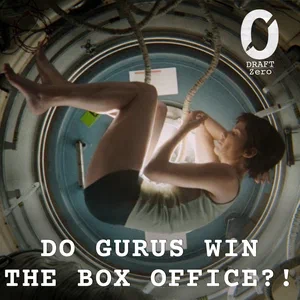
Do the biggest original films of 2013 follow more archetypal - or formulaic - structures?
AI✦The episode’s central question hinges on whether these films follow archetypal plotting structures like those outlined by Vogler and Snyder or rely instead on formulaic story beats.✦
Listen if you need to know which guru frameworks actually deliver in Act Three.
▶
More Info
Part 2 of our Screenplay Gurus series takes the same lens from Part 1 — Vogler, Snyder and Hauge — and points it at the two highest-grossing original films of 2013: GRAVITY and FROZEN. No franchise, no sequel. Just the two films that audiences went to see in the biggest numbers that year, and the question of what their scripts actually look like when you run them against the guru formulas…
→
Do Oscar-Nominated screenwriters follow the structural formulas prescribed by the 'gurus' and books?
AI✦Stu and Chas repeatedly examine how both scripts structure their major plot points against Snyder, Hauge, and Vogler’s prescribed beat sheets, finding that neither film adheres cleanly to the formulas despite being Oscar-nominated successes.✦
Listen if you want to know whether Blake Snyder, Michael Hauge and Christopher Vogler's structural theories actually apply to Academy Award-nominated screenplays
▶
More Info
Three of the most widely read structure books in screenwriting — Snyder’s
Save the Cat, Vogler’s
The Writer’s Journey, and Michael Hauge’s
Six Stages — all make essentially the same claim: this is how great films are built. In our debut episode, we run that claim against two Oscar-nominated films to see if it holds: PHILOMENA and DALLAS BUYERS CLUB…
→
How can Secrets and Clues motivate characters?
AI✦Mel and Chas discuss plotting from a character perspective and reverse-engineering a mystery by visualizing how clues function differently depending on whether they’re pointers, plants, or underpinnings--connecting game design’s node-based structure to mystery construction.✦
Listen if you want to understand how hidden information drives character motivation and plot structure!
▶
More Info
“Getting information puts your character in danger. And danger rewards your character with information." — One of three ideas we steal from game design in this episode. In this two part series, we talk about how secrets, clues and hidden information motivate characters and may (or may not) help you plot from a character perspective. Part One (this episode) looks at WAKE UP DEAD MAN; while Part Two (DZ-127) looks at SIDE EFFECTS, and the pilot episode of SHRINKING…
→

What magic do Christmas movies use to make them so rewatchable?
AI✦The episode credits intricate plots as a structural ingredient that keeps holiday films engaging and rewatchable, suggesting complexity as an antidote to predictability.✦
Listen if you want to understand what makes holiday films enduring parts of our seasonal rituals!
▶
More Info
In this “backmatter” episode of Draft Zero, Stu, Chas, and Mel Killingsworth embark on a festive exploration of what makes holiday films so engaging and so re-watchable that they can become part of our rituals. To that end, we breakdown the charm of of Christmas films like KISS KISS BANG BANG, RIDERS OF JUSTICE, and IT’S A WONDERFUL LIFE…
→
How can the same story feel different when you have more characters?
AI✦The episode lays groundwork for understanding how ensemble narratives are plotted differently, using contrasting pairs like TOP GUN versus TOP GUN: MAVERICK to show structural divergence.✦
Listen if you're working on a story with multiple protagonists and want to understand what makes an ensemble different from a single-protagonist narrative
▶
More Info
In the first part of our series on ensembles, Chas, Stu and Mel start by laying the groundwork for our future episodes. And we begin by asking the seemingly innocuous question:
What do we mean by calling a story an ensemble?…
→
How do you choose which project to start next?
AI✦Hyperlink cinema--the interwoven narrative structure--gets discussed as an approach to organizing multiple storylines within a single project.✦
Listen if you're starting a new co-writing relationship, managing multiple projects, or wondering how to prioritize your next screenplay.
▶
More Info
In their now-annual full backmatter episode, Stu and Chas let their hair down, drop the guise of objectivity, and allow themselves to have an even more subjective opinion about writing and the business of writing…
→
How can shifting narrative point of view drive your sequences?
AI✦The episode demonstrates how narrative POV functions as a plotting tool--not what happens, but what we’re allowed to know about what happens becomes the architecture of the mystery itself.✦
Listen to help you master the gap between what your audience knows and what your characters know.
▶
More Info
Born out of isolation madness, this episode is an edited version of Draft Zero’s first YouTube livestream. Stu and Chas both watched KNIVES OUT and - together with our listeners - broke down each sequence and turning point by reference to what the audience knows in relation to the characters (aka narrative point of view). They then answer listener questions on KNIVES OUT and much else besides live on air…
→
How can writers wisely invest their time in projects?
AI✦Doing ‘you down work first’ reflects the hosts’ conviction that structural clarity pays dividends before investing heavily in drafting, a prioritization question central to time-wise project management.✦
Listen if you're juggling multiple projects and can't figure out which one deserves your attention right now.
▶
More Info
In this “special”, backmatter-only episode, Stu & Chas take inspiration from Terry Rossio’s excellent article on TIME RISK and ice skate over a range of topics. We talk about time investment in projects, Stuart’s project Restoration, doing you down work first, managing feedback, thinking positive being a negative, and we open the listener mail bag for critiques, praise and suggestions. We also explore how we could do Draft Zero episodes exploring tone and theme…
→
How do screenwriters get away with using coincidences in their stories?
AI✦Chas and Stu analyze how writers engineer plot progression in films like MICHAEL CLAYTON and FINDING NEMO, distinguishing between character-driven forward motion and story-driven necessity.✦
Listen when you need to know which coincidences earn trust and which ones feel like cheating.
▶
More Info
Remember that time in THE DARK KNIGHT RETURNS when Bruce suddenly - magically - returned to Gotham, and you were like “WTF?!” Well, it turns out that many of the best films have moments that are just as coincidental or contrived (or a flock of Giant Eagles) and yet get away with it. Does Pixar’s “rule” that it is ‘cheating to use coincidences to get your characters out of trouble’, always apply…
→
Can one scene be the key to unlocking the whole story?
AI✦Using a key scene as a generative tool means you can build your three-act structure outward from that one encounter if you understand the characters’ competing desires and worldviews.✦
Listen if you want to understand how a single key scene between protagonist and antagonist can unlock the entire structure of your story!
▶
More Info
Can one scene be the key to unlocking the whole story…
→