"There are two layers to the character’s arc, or three really, which is what happens to the character: do they change? Or not change? For the better or worse? What is the character’s experience of that or belief of that? Do they believe they’ve changed for better or for worse? And then the third is what is the audience perspective on that? So a character can change, that’s the first kind of filter: have they changedm have they not? Then there’s the judgment layer from the character which is: do I believe this is for the better or for the worse? And then there’s our perception of that."
— Stu Willis | DZ-128: What even is a Character Arc?
Three Layers Of Character Arc
"There are two layers to the character's arc, or three really, which is what happens to the character: do they change? Or not change? For the better or worse? What is the character's experience of that or belief of that? Do they believe they've changed for better or for worse? And then the third is what is the audience perspective on that? So a character can change, that's the first kind of filter: have they changedm have they not? Then there's the judgment layer from the character which is: do I believe this is for the better or for the worse? And then there's our perception of that."
— Stu Willis
(00:11:11)
· DZ-128: What even is a Character Arc?
Emotional Authenticity Over Spectacle
"I do think it's here. We can resist it. And I think we should think about the ways and we resist it, but all that stuff. I actually think the stuff that's going to become more valuable as both a consumer and a creator is stuff that's more emotionally authentic. The stuff that actually I think on a quote unquote business, not quote unquote, like the stuff that is going to be affected on a business level is spectacle. That's the stuff that's kind of becoming easier to reproduce. The stuff that I think is going to become more precious is the stuff that breaks your heart."
— Stu Willis
(00:20:27)
· DZ-128: What even is a Character Arc?
The Power of Honest Acknowledgement
"There are story paradigms where all the characters are aware of all the information, and the power in that situation -- where it's the audience being behind all the characters -- is that the power comes from those moments where the audience catches up because the characters are being honest. [...] The whole show, the stakes are all mental health stakes. And it's those moments of insight and truth where everyone else around them knows what they're saying -- it's not a secret to them. But the power comes from the characters being able to acknowledge their own weaknesses or their own shortcomings or their own moments of insight, and letting their dishonesty go, letting their safety nets go, becoming vulnerable."
— Chas Fisher
(01:22:08)
· DZ-127: Secrets and Clues 2 - The Cost of Revelation
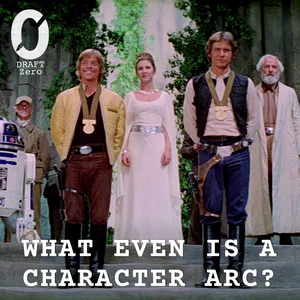
What effect does character changing have on the audience?
AI✦Chas articulates that the choice of whether characters arc and how they transform is ultimately about what emotional experience you want the audience to have in relation to your story.✦
Listen to separate the three layers of an arc -- does the character change? How do they feel about it? And how is the audience positioned to feel about it?
▶
More Info
Stu, Chas and Mel finally begin their long-awaited journey into CHARACTER ARCS. In this “primer” episode, we try find some learnings and analytical lenses that we can then apply in future breakdowns…
→
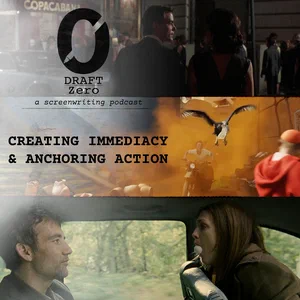
What can we learn by analysing how 'oners' are written on the page?
AI✦Stu argues that the core objective of a oner is to create that sense of unity while bonding us with character experience, and Mel shows how this rhythmic structure--whether breathless like Goodfellas or claustrophobic like Children of Men--shapes what the audience feels in the moment.✦
Listen to understand how screenwriters direct the camera without calling shots.
▶
More Info
Chas, Stu and Mel reunite to talk about writing the
feel of camerawork in screenplays. We use “oners” — a long-playing continuous take — as a lens to talk about how some writers have “directed” from the page. We talk immediacy, camera positions, handovers, and anchoring action and more…
→
How can you keep your audience hooked when they know the end of the story?
AI✦The episode proposes that emotional stakes--not plot stakes--are what land with an audience when they’re watching a story whose outcome is predetermined.✦
Listen listen if you're writing a biopic or any story where the audience already knows how it ends.
▶
More Info
Chas, Stu and Mel take a deep dive into stakes, using then lens of biopics to help us think about them. If an audience already knows the “plot” outcome of a story, then how do you create stakes to make a story tense for the audience…
→
What is difference between choice and decision when it comes to audience experience?
AI✦The episode tracks how the sequencing of choice, decision, and consequence in non-linear narrative affects how audiences feel about characters, using WRATH OF MAN as the primary case study.✦
Listen when you want to show a character refusing to change despite every opportunity to do so.
▶
More Info
In our second part of our “series” on Choices & Decisions, we take a deep dive into THE FAREWELL and WRATH OF MAN, with a sidebar on NOMADLAND…
→
What is the difference between choice and decision when it comes to characters?
AI✦The episode argues that how you separate choice, decision, and consequence fundamentally changes what the audience feels about a character, making this a tool for managing emotional response.✦
Listen how the separation of choice, decision, and consequence (for a character) creates emotional impact.
▶
More Info
In order to better understand dramatising of character, Chas and Stu take a very draft zero look at very specific tool: choices and decisions. We analyse three films through the decisions made by their characters. In particular, how the audience understanding of: the choice available, the considered decision itself, and the consequence changes how we feel about these characters. And how separating those three things can create different emotional effects on your audience…
→
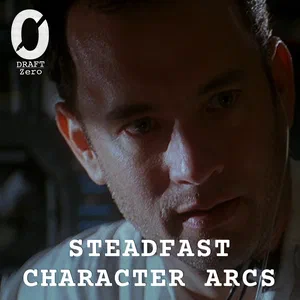
How do you write a satisfying story when your character never changes
AI✦The group examines how additive rewards (gaining something) versus subtractive ones (losing something) create different emotional responses, explaining why a happy ending can still feel like loss.✦
Listen to learn how to move an audience with a character who never changes.
▶
More Info
Do characters need to change for you to have a satisfying story? That’s a question we’ve been asking since, like, episode five of this podcast. And we’re finally talking about them - whatever you call ’em: steadfast, resilent, or flat arcs…
→
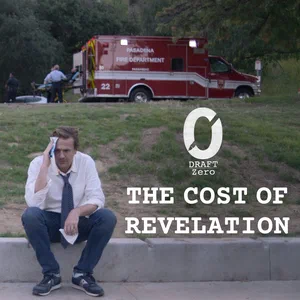
What does it cost a character to find something out, or to say it?
AI✦Mel emphasizes that the power in Shrinking comes not when the audience learns information, but when characters reveal truth--a distinction that separates where emotional force actually lands in this kind of storytelling.✦
Listen to learn the emotional impact of revealing secrets vs discovering them.
▶
More Info
In this episode Stu, Chas and Mel apply the Landmark–Hidden–Secret framework (from DZ-126) across two very different genres: the thriller SIDE EFFECTS (2013) and the tragicomic pilot of SHRINKING…
→
How can you use physical objects to track character change… wordlessly?
AI✦Chas and Stu examine how the emotional weight of a talisman--whether Mjolnir’s symbolic burden or the charged spaces in In the Mood for Love--creates powerful moments that land without exposition.✦
Listen to write objects that accumulate powerful meanings across your story and create unspoken emotional payoffs.
▶
More Info
In part two of our two-part series on TALISMANS, we break down the beats used to turn objects (in a broad sense) into talismans; how talismans can track character journeys and transitions; and how they can be used to create powerful moments without words…
→
How can endings prompt an audience to reflect on your story?
AI✦The episode centers on endings that make audiences pause and reflect, examining how recognition moments--whether in characters, the world, or the audience--create lasting emotional resonance.✦
Listen if you want to write endings that make audiences pause and ponder (in a good way, obvs)
▶
More Info
Stu & Chas set out to explore what makes certain endings powerful, in particular those of LA LA LAND, INCEPTION, NO COUNTRY FOR OLD MEN and TURNING RED. The lens they bring to those endings is Aristotle’s moment of “anagnorisis” (don’t worry - we can’t pronounce it either), traditionally when a character moves from ignorance to knowledge (particularly of self)…
→
How can you use setups and payoffs to stitch your film together?
AI✦Chas traces where the film lands emotionally--the moment Waymond explains his kindness as strength, the final jump off the cliff--showing how payoffs to planted relationship beats generate cathartic release despite the genre chaos.✦
Listen to understand how setups, payoffs, and reversals create narrative cohesion even when your story is fkn bonkers.
▶
More Info
In this one-shot, Chas and Stu jump into the utter chaos of EVERYTHING EVERYWHERE ALL AT ONCE. Y’know, nultiverses, butt-plug action sequences, hot-dog fingers, a raccoon chef, a nihilist bagel. All the good stuff. And yet it lands emotionally in a way that feels inevitable…
→