2026
How do you write a satisfying story when your character never changes
AI✦The group examines how additive rewards (gaining something) versus subtractive ones (losing something) create different emotional responses, explaining why a happy ending can still feel like loss.✦
Listen to learn how to move an audience with a character who never changes.
▶
More Info
Do characters need to change for you to have a satisfying story? That’s a question we’ve been asking since, like, episode five of this podcast. And we’re finally talking about them - whatever you call ’em: steadfast, resilent, or flat arcs…
→
What effect does character changing have on the audience?
AI✦Chas articulates that the choice of whether characters arc and how they transform is ultimately about what emotional experience you want the audience to have in relation to your story.✦
Listen to separate the three layers of an arc -- does the character change? How do they feel about it? And how is the audience positioned to feel about it?
▶
More Info
Stu, Chas and Mel finally begin their long-awaited journey into CHARACTER ARCS. In this “primer” episode, we try find some learnings and analytical lenses that we can then apply in future breakdowns…
→
2025
"The first episode is a very classic thriller. You’re discombulated, you’re with the characters, right? You’re going through this discombulating experience, you’re playing catch up. So there’s a lot of these plot questions about like what has happened, what is he accused of, you know, all these kinds of questions, which are kind of plot questions, kind of keep us hooked."
— Stu Willis | DZ-118: ADOLESCENCE -- How Questions Create Dramatic Tension
How do dramatic questions create tension?
AI✦The episode’s central argument is that ’the absence of plot does not mean the absence of tension,’ and Stu and Chas show how the writers achieve urgency and immediacy through unity of time and POV architecture rather than external stakes.✦
Listen when you need tension without external stakes--subtext, stillness, and thematic weight do the work.
▶
More Info
In this episode, Stu and Chas delve into the cultural phenomenon of ADOLESCENCE. We try to find the craft tools that have made the show so compelling and such a catalyst for conversation…
→
2024
"I think unreliable narrators are ultimately connected to the fact that the character wants something from the audience, right? And so the unreliability comes from both a combination of what this character knows, but also what they want you to know."
— Stu Willis | DZ-110: Voiceover
How can you use voiceover without it feeling like a cheat?
AI✦Stu shows how voiceover, when timed from the right moment in the character’s timeline, becomes a direct pipeline to viewer empathy and investment.✦
Listen to explore how voiceover can set tone, reveal character, enhance empathy, and create tension.
▶
More Info
How can you use Voiceover without it feeling like a cheat?…
→
2023
"In some stories it’s really fascinating to watch how maybe one of the characters doesn’t really understand the situation they’re in. They don’t know they’re in a negotiation. They don’t realise they’re actually in an argument. They’re not aware they’re being broken up with, or literally, they’re not aware that they’re in a fight. And it’s watching how those different expectations are in conflict, not just the two people."
— Damon Young | DZ-100: Scenes through Swords
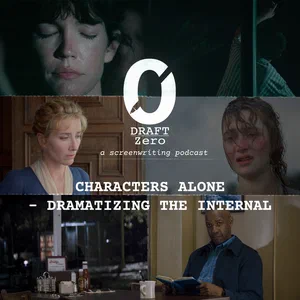
How can scenes where characters are alone increase our connection with them?
AI✦By examining how solitude creates intimacy between character and audience, Chas and Stu show that witnessing vulnerability when no one else is watching builds connection.✦
Listen to understand how solitude reveals character interiority and deepens audience connection
▶
More Info
In this episode, we explore the audience’s connection with characters through the lens of characters being alone…
→
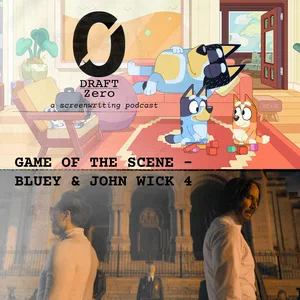
How can 'games' help us write better scenes?
AI✦Stu and Chas use examples from John Wick 4 and Bluey to show how clear game rules and win conditions generate tension through uncertainty about who will win.✦
Listen to make your scene writing more dynamic (by looking at the underlying game)
▶
More Info
Stu and Chas turn their attention to a topic that has long eluded them: the game of the scene. We look at how considering the game that characters are playing — its rules, arenas, players, referees, and win conditions — can help you write more dynamic scenes…
→
What scene-writing tools can be learned from martial arts?
AI✦The discussion of distance between combatants and the timing of engagement shows how physical and psychological spacing generates the pressure that sustains a conflict scene.✦
Listen if you want to know why the distance between two characters matters more than what they say.
▶
More Info
In this slightly unusual episode of Draft Zero (but also incredibly on brand), Stu and philosopher-swordsperson Damon Young discuss how the lessons they have learned from martial arts can be applied to scenes. In particular, they discuss how approaching an opponent in a sword fight can be analogous to how characters approach conflict, such as: the distance between the characters, who chooses to engage first, how to feint, how to lure an attack by leaving yourself vulnerable, etc…
→
2022
How can endings prompt an audience to reflect on your story?
AI✦Stu and Chas use Aristotle’s anagnorisis as the central lens for understanding how endings move characters from ignorance to knowledge, particularly of self.✦
Listen if you want to write endings that make audiences pause and ponder (in a good way, obvs)
▶
More Info
Stu & Chas set out to explore what makes certain endings powerful, in particular those of LA LA LAND, INCEPTION, NO COUNTRY FOR OLD MEN and TURNING RED. The lens they bring to those endings is Aristotle’s moment of “anagnorisis” (don’t worry - we can’t pronounce it either), traditionally when a character moves from ignorance to knowledge (particularly of self)…
→
How can you keep your audience hooked when they know the end of the story?
AI✦The central question of how to keep an audience hooked in predetermined-outcome stories hinges on understanding what creates tension beyond plot surprise.✦
Listen listen if you're writing a biopic or any story where the audience already knows how it ends.
▶
More Info
Chas, Stu and Mel take a deep dive into stakes, using then lens of biopics to help us think about them. If an audience already knows the “plot” outcome of a story, then how do you create stakes to make a story tense for the audience…
→
2021
"And I think certainly in Nanette, Hannah Gadsby has comments on the fact that she has been using jokes as a distancing mechanism, as a way to distance herself from her traumatic experience, a way of rewriting those traumatic experiences, a way of getting the dig in before other people do."
— Alice Fraser | DZ-83: A Very Thematic Stand-up Special!
What is difference between choice and decision when it comes to audience experience?
AI✦The episode tracks how the sequencing of choice, decision, and consequence in non-linear narrative affects how audiences feel about characters, using WRATH OF MAN as the primary case study.✦
Listen when you want to show a character refusing to change despite every opportunity to do so.
▶
More Info
In our second part of our “series” on Choices & Decisions, we take a deep dive into THE FAREWELL and WRATH OF MAN, with a sidebar on NOMADLAND…
→
What is the difference between choice and decision when it comes to characters?
AI✦The episode argues that how you separate choice, decision, and consequence fundamentally changes what the audience feels about a character, making this a tool for managing emotional response.✦
Listen how the separation of choice, decision, and consequence (for a character) creates emotional impact.
▶
More Info
In order to better understand dramatising of character, Chas and Stu take a very draft zero look at very specific tool: choices and decisions. We analyse three films through the decisions made by their characters. In particular, how the audience understanding of: the choice available, the considered decision itself, and the consequence changes how we feel about these characters. And how separating those three things can create different emotional effects on your audience…
→

What can screenwriters learn from the storytelling techniques used by stand-up comedians?
AI✦The rhetorical concept of pathos--how the audience emotionally engages--becomes the key tool for understanding why stand-ups can move viewers to both laughter and catharsis.✦
Listen if you want to understand how stand-up comedians grip audiences and build emotional arcs (and what narrative tools screenwriters can borrow from comedy)!
▶
More Info
Standup comedians can keep audiences gripped to their every word for over an hour, and often bring them to emotional climaxes by the end. So how do they do it and what tools can apply to scripted narratives…
→
How can interweaving two timelines change how we feel about a character?
AI✦The episode’s core work is examining how the interweaving timelines change how the audience feel about Mark Zuckerberg, and whether Sorkin’s structure creates sympathy or something more complex.✦
Listen to understand how manage stakes when you're using flashforwards.
▶
More Info
In this Part 2 of Interweaving Timelines (aka The Stu Monologue Episode), Mel, Chas and Stu tackle Sorkin/Fincher’s The Social Network. As you’ll hear, it is clearly Stu’s favourite of the examples we cover and, ah,
not Mel’s favourite. While all three bring their own biases and opinions on the reality of Facebook as it has become, we do manage to put the destruction of democracy to one side to actually analyse the meticulous craft that this film displays…
→
How does interweaving two timelines change how the audience feel?
AI✦Stu and Chas examine what questions the interweaving of timelines prompts in viewers, treating audience inquiry as a direct consequence of non-linear storytelling choices.✦
Listen when you're writting multiple timelines and struggling to anchor your reader to one timeline's perspective.
▶
More Info
Stu and Chas are joined by Mel Killingsworth to dissect interweaving timelines. Not anthology films. Not Cloud Atlas. But films where two plot lines featuring the same characters, but from different timelines, are woven together…
→
2020
How can you use audience questions to heighten emotional investment?
AI✦The episode’s central framing examines how Parasite uses audience questions as a deliberate craft tool to heighten emotional investment throughout the film.✦
Listen to understand how refusing to give your audience moral clarity can deepen their investment in character fates.
▶
More Info
Draft Zero return with their next YouTube livestream! Stu and Chas take a deep dive into PARASITE and how its mastery of audience questions elevates the film. They then answer listeners questions on PARASITE and much more…
→
2019
Do you want your audience feeling with or for your characters?
AI✦The episode distinguishes between positioning your audience to sympathise with characters--being rocked by surprise after the fact--versus other modes of connection.✦
Listen if you're interested in how to dramatise character change, position your audience in relation to characters, and explore the difference between empathy and sympathy in screenwriting
▶
More Info
One day, Chas saw
Avengers: Endgame for the second time and wrote a review on Letterboxd. In particular, he had issues with how little he perceived the characters of Cap and Tony changed within the film, their big finale (spoiler). Then friend and patron of the podcast Julio Olivera vehemently disagreed in the comments. He was egged on by Stu. And there in the comments began a debate that looked a lot like an episode of Draft Zero. So we decided to make it one…
→
Workshopping ways to fix character motivations.
AI✦When characters make decisions the audience doesn’t believe, sympathy fractures; Chas and Stu trace how failures of motivation directly undermine the emotional contract with viewers.✦
Listen if you want to understand how character decisions can break a screenplay and how to fix them
▶
More Info
In this second part of their exploration of character motivations, Chas and Stu dive into what makes “BAD” screenplays NOT work. They examine at moments where they (and maybe you, dear listeners) did not believe a key decision being made by a character and so were taken out of the movie. In a departure from the Draft Zero format, they apply the tools they developed in Part 1 to workshop potential fixes to these beats…
→
2018
Will Director Stu allow Writer Chas on his set?
AI✦The hosts investigate how consequences of character actions do heavy lifting in determining whether audiences will sympathize with or reject a character.✦
Listen to understand how consequences (not intentions) impact whether an audience roots for or against your protagonist.
▶
More Info
Following our annual wrap up in 2017, we’ve decided to once again explore what craft issues/lessons we can garner from the latest Stars, namely Episode VIII: The Last Jedi, focusing on how consequences of character actions can do a lot of heavy lifting as to how the audience perceives that character (as well as looking at worldview and overall story structure)…
→
2017
What questions do you want your audience asking at any given time?
AI✦The episode’s central question asks what questions you want your audience asking at any given time, using narrative POV as the mechanism to generate and sustain those questions throughout your story.✦
Listen if you want to understand how narrative point of view can organise your entire story structure
▶
More Info
Waaaaaaaaaay back in DZ-5, Stu and Chas examined how shifting narrative point of view (i.e. what the audience knows in relation to the characters on screen) heightens emotions in any given scene. We’ve now taken that micro idea and applied it to the macro: how can deciding what the audience knows and when in relation to the characters organise your story? Are whole sequences or even acts driven by the audience following a character, feeling concerned about a character, empathising with a character or being absorbed in the irony of knowing more than all the characters interacting on screen…
→
2016
How does the experience of a character's decision impact our feelings towards that character?
AI✦By comparing Sansa’s absent POV in one episode to Cersei’s present POV in another, Chas and Stu show how a writer’s choice to show or hide a character’s decision-making directly shapes whether an audience feels aligned with or alienated from that character.✦
▶
More Info
After a spectacular end to Season 6 of GAME OF THRONES, Chas and Stu were struck by the very different portrayals of Sansa in
Episode 9 - Battle of the Bastards and Cersei in
Episode 10 - The Winds of Winter. Despite both characters having an enormous impact on the narrative, the audience’s experience of those characters is very different -- largely because Sansa is absent from 98% of Battle of the Bastards…
→
How can you recreate the feeling of cinematic high-tension on the page?
AI✦Chas and Stu dissect how screenwriters evoke fear and tension on the page alone, without relying on the director’s toolkit of camera, lighting, music, or sound.✦
Listen if you want to evoke fear and tension using only the written word (without relying on camera, lighting, music, or sound).
▶
More Info
Chas & Stu take a close look at sequences of high-tension - the ones that make you lean forward in fear, or jump backwards in terror. Without camera angles, lighting, music or sound, how can screenwriters can evoke those emotions in readers using only the page? These sequences can be found in any genre of film, not just thriller or horror. To that end, Stu and Chas dive into high tension scenes from NO COUNTRY FOR OLD MEN, ZODIAC, ROOM, and THE BABADOOK. We cover their use of shifting POV, Dramatic Irony, Status Transactions, White Space, Sound FX, and many more…
→
What makes a script so compelling that it ends up with an Oscar nod?
AI✦Stu and Chas examine how Oscar-nominated screenplays like Spotlight and Carol engineer catharsis as a cornerstone of their emotional power and audience impact.✦
Listen to learn how catharsis, world-building, mid-points, and status transactions elevate great writing
▶
More Info
In this episode Stu and Chas return to their first ever episode by tackling two Oscar-nominated screenplays. But this time - instead of exploring the rigid structures laid down by gurus - they use it as an opportunity to explore what they’ve learned in the last three years and apply them to the phenomenal writing in SPOTLIGHT and CAROL (with slight digression towards THE EXPANSE and GAME OF THRONES (which has possibly replaced Star Wars as the de facto reference point for anything.)…
→
2015
How do you keep contained movies engaging?
AI✦The central problem the episode tackles is how good contained films hook and sustain audience interest when traditional momentum-building techniques--multiple locations, intercutting between characters--are unavailable.✦
Listen if you're writing a contained thriller, drama, or any story limited to a single location
▶
More Info
Contained Thrillers* *seem to be a genre that never goes out of fashion. But being contained is not just limited to thrillers. It’s a way of telling stories on a lower budget, regardless of genre. So - while allegedly easier to make / get made - limiting a story to a single location also limits the tools that maintain an audience’s interest. Changing audience or character point of view, intercutting between locations or characters are all much harder (if not impossible) in contained films. So how do good contained films hook their audience and keep them…
→
How do you make unlikeable characters compelling to watch... in drama?
AI✦The central question asks how screenwriters generate audience buy-in for unlikeable characters, which means finding ways to make viewers care about people they’d otherwise despise.✦
Listen when you're writing a protagonist who does terrible things but you need the audience to keep watching.
▶
More Info
Stu and Chas revisit a topic from a year ago: how do screenwriters make unlikeable characters compelling? This time, we turn our focus to dramas and analyse how AMERICAN HISTORY X, YOUNG ADULT, NIGHTCRAWLER all make their asshole protagonists compelling to watch. We expand our original list of five writer’s tools to include a few more for your tool belt…
→
2014
"The dog peeing on the wall... they needed to show why Melvin dislikes the dog. So, we understand the motivation behind extreme action, even if we don’t agree with the action itself."
— Stu Willis | DZ-3: Making Unlikeable Protagonists Compelling
Can forcing your audience to ask questions - and then answering them - trigger an emotional response?
AI✦The episode’s central thesis is that forcing your audience to ask questions and then answering them triggers emotional response, making question generation the engine of the craft.✦
Listen to learn about the most powerful tool in screenwriting: narrative POV.
▶
More Info
Stu and Chas delve into audience point of view - not character point of view! Does your audience know more, less or the same as your characters? And does changing this within a scene trigger or heighten the desired emotional response…
→
How does the end of certain films make your soul shudder?
AI✦Stu and Chas examine how Aristotle’s theory of catharsis--that soul-shuddering emotional release--can be engineered through a fixed sequence of beats in your final pages.✦
Listen if you want to make you endings great!
▶
More Info
Stu and Chas are joined by their first guest – illustrious script developer and producer Stephen Cleary – to explore how certain films can trigger an outpouring of emotion from the audience. Turns out that Aristotle may have figured it out a few thousand years ago and called it Catharsis…
→

How do you keep an audience watching a character everyone in the film hates?
AI✦Chas and Stu identify specific techniques )the yin-yang oscillation of cruelty followed by complicating beats, extreme behavior that provokes laughter rather than recoil) that allow audiences to care about deeply flawed protagonists despite their unlikability.✦
Listen if you want to make audiences care about deeply flawed protagonists!
▶
More Info
In this episode, Stu and Chas try to work out what stops a-holes protoganists from pushing the audience out of the movie…
→