"So I think there’s the referees, there’s the arena, the victory conditions important and it leads into this other idea, speaking of board games, of like the path to victory."
— Stu Willis | DZ-102: Game of the Scene - Bluey, John Wick 4

How do you make extended technical scenes funny on the page?
AI✦The episode treats formatting and action-line construction as deliberate craft tools rather than mere description: repetition, rhythm, white space, and strategic capitalization all work together to make extended physical comedy readable and funny.✦
Listen to learn how formatting--white space, caps, dashes--becomes your comedy toolkit without a director.
▶
More Info
Mel joins Chas to tackle physical comedy. We limited our homework selection to extended scenes (as opposed to moments and sight gags) in live action projects and – with the help of our Patreons – selected early sequences from BRINGING UP BABY, the pilot for HAPPY ENDINGS and that wonderful food poisoning scene in BRIDESMAIDS…
→
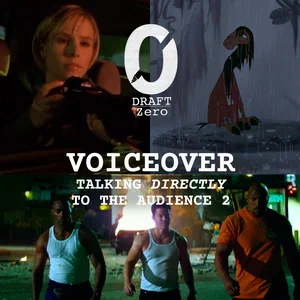
How can you use voiceover without it feeling like a cheat?
AI✦This episode treats voiceover as part of a larger toolkit for allowing characters and storytellers to speak directly to the audience, with specific levers to pull when deploying it.✦
Listen to explore how voiceover can set tone, reveal character, enhance empathy, and create tension.
▶
More Info
How can you use Voiceover without it feeling like a cheat?…
→
How can we use dramatisation to create tone?
AI✦Stu’s tone triangle functions as a generative craft tool--a three-pointed framework for writers to diagnose and adjust the tonal levers they have available in their own scripts.✦
Listen if you want to understand how character actions and reactions shape a film's tone
▶
More Info
In this episode, Chas and Stu continue their deep dive into how to write tone by examining films with “light” (we use the phrase loosely) tones: LADY BIRD, EMILY THE CRIMINAL, THE BALLAD OF BUSTER SCRUGGS, and SPONTANEOUS. We also talk a surprising amount about DUNE and CRAZY STUPID LOVE…
→
How can we teach the reader to find the humour in our darkness?
AI✦The episode treats tone-setting as a learnable craft with specific levers and techniques that Chas and Stu extract from the opening pages of working scripts.✦
Listen if you want to use an unusual tone in your screenplay.
▶
More Info
Chas and Stu finally start their long-mooted exploration of tone with a series that examines films and shows with unusual tones and dives into how the writers establish those tones in the first 5 pages…
→
How can 'games' help us write better scenes?
AI✦The framework of rules, arenas, players, referees, and win conditions functions as a diagnostic tool for writers trying to understand why a scene isn’t landing.✦
Listen to make your scene writing more dynamic (by looking at the underlying game)
▶
More Info
Stu and Chas turn their attention to a topic that has long eluded them: the game of the scene. We look at how considering the game that characters are playing — its rules, arenas, players, referees, and win conditions — can help you write more dynamic scenes…
→
What can we learn by analysing how 'oners' are written on the page?
AI✦The episode treats oner construction as a learnable craft tool--breaking down specific techniques from major films to show how any screenwriter can direct the reader’s eye on the page.✦
Listen to understand how screenwriters direct the camera without calling shots.
▶
More Info
Chas, Stu and Mel reunite to talk about writing the
feel of camerawork in screenplays. We use “oners” — a long-playing continuous take — as a lens to talk about how some writers have “directed” from the page. We talk immediacy, camera positions, handovers, and anchoring action and more…
→
How can you use physical objects to reveal inner character?
AI✦Chas and Stu position talismans as a concrete craft instrument you can deploy intentionally in your script, distinct from accident or theme, to access and communicate character.✦
Listen to so you can write talismans that are powerful tools for accessing character!
▶
More Info
In this series, Chas and Stu discuss TALISMANS. Physical objects that are imbued with meaning by a character or characters. They’re a powerful tool to access inner character…
→
How do you determine what is your MVP?
AI✦The minimum viable product and minimum loveable thing serve as diagnostic tools that Stu and Chas use to help writers determine which elements of their project are essential.✦
Listen for screenwriting lessons from 2021, strategies for pitching projects, and insights on running a writers workshop
▶
More Info
In their annual full backwater episode, Stu and Chas let out their pandemic hair, drop the ruse of objectivity, and allow themselves to have even more options about writing and the business of writing…
→
How can you create flow and contrast in your dialogue?
AI✦The episode explicitly develops reusable dialogue tools--the hook and eye, contrast and affinity, pacing strategies--that writers can apply to their own work.✦
Listen when you're rewriting dialogue and want to create connection between characters.
▶
More Info
A full three years after the first instalment (and one of our most popular), Stu and Chas have kidnapped Stephen Cleary to once again develop some craft tools around dialogue. It would be fair to say that - in that time - all three have learnt a lot more about dialogue than they knew in 2016. It would be also fair to say that Stephen perhaps learnt a little more through his research into “genderlect”…
→
How can unfilmables enhance the experience of your script?
AI✦Chas and Stu position unfilmables as practical craft tools writers can deploy in micro moments to describe locations, set tone, enhance performance, and land specific types of humour.✦
Listen to discover how *produced* screenplays use unfilmables to shape tone, performance, and humour on the page.
▶
More Info
*AKA Why your screenwriting guru is wrong *…
→
Films:
Lethal Weapon (1987)
,
Hereditary (2018)
,
A Quiet Place (2018)
,
Killing Them Softly (2012)
,
Spartan (2004)
,
The Girl on the Train (2016)
,
The Nice Guys (2016)
,
Drive (2011)
,
Michael Clayton (2007)
,
The Tree of Life (2011)
,
Three Billboards Outside Ebbing, Missouri (2017)
,
Killing Eve (2018)
,
Fleabag (2016)
,
Sharp Objects (2018)
,
Battlestar Galactica (2004)
Workshopping ways to fix character motivations.
AI✦The episode applies the motivational tools developed in Part 1 as practical rewriting instruments, moving from diagnosis to concrete fixes for broken character moments.✦
Listen if you want to understand how character decisions can break a screenplay and how to fix them
▶
More Info
In this second part of their exploration of character motivations, Chas and Stu dive into what makes “BAD” screenplays NOT work. They examine at moments where they (and maybe you, dear listeners) did not believe a key decision being made by a character and so were taken out of the movie. In a departure from the Draft Zero format, they apply the tools they developed in Part 1 to workshop potential fixes to these beats…
→
How can you recreate the feeling of cinematic high-tension on the page?
AI✦The episode treats tension-building as a toolkit problem -- identifying specific, replicable techniques like POV shifts and white space that writers can apply across genres.✦
Listen if you want to evoke fear and tension using only the written word (without relying on camera, lighting, music, or sound).
▶
More Info
Chas & Stu take a close look at sequences of high-tension - the ones that make you lean forward in fear, or jump backwards in terror. Without camera angles, lighting, music or sound, how can screenwriters can evoke those emotions in readers using only the page? These sequences can be found in any genre of film, not just thriller or horror. To that end, Stu and Chas dive into high tension scenes from NO COUNTRY FOR OLD MEN, ZODIAC, ROOM, and THE BABADOOK. We cover their use of shifting POV, Dramatic Irony, Status Transactions, White Space, Sound FX, and many more…
→
How can scene transitions do more than just move from one location to another?
AI✦Stu and Stu treat transitions as a concrete, learnable craft tool by reverse-engineering specific examples from HIGHLANDER and AMERICAN SPLENDOR to show which choices were writerly decisions.✦
Listen to understand how transitions compress time, enhance thematic connections, unify story threads, and orient your reader
▶
More Info
Stu and Chas look at one of the basic building blocks of a script: scene transitions. Transitions don’t just move you from one scene to another in a slick way, they can help you compress time, enhance thematic connections, unify different story threads, orient (or disorient) your reader... and just make your script feel more like a movie… →
How do you make unlikeable characters compelling to watch... in drama?
AI✦The episode expands a five-tool list into a more comprehensive toolkit for screenwriters working with unlikeable protagonists in dramatic contexts.✦
Listen when you're writing a protagonist who does terrible things but you need the audience to keep watching.
▶
More Info
Stu and Chas revisit a topic from a year ago: how do screenwriters make unlikeable characters compelling? This time, we turn our focus to dramas and analyse how AMERICAN HISTORY X, YOUNG ADULT, NIGHTCRAWLER all make their asshole protagonists compelling to watch. We expand our original list of five writer’s tools to include a few more for your tool belt…
→
Does manipulating time on the page make your script feel more cinematic?
AI✦Khrob brings Soviet Montage Theory and the Kuleshov effect into the conversation as specific craft tools screenwriters can apply to recreate time manipulation on the page.✦
Listen if you want your screenplay to feel cinematic before a director ever reads it.
▶
More Info
Chas and Stu are joined by Khrob Edmonds - an award-winning filmmaker - to discuss manipulation of time…
→
It's the The Podcast You Used To Know…
AI✦Chas and Natasha discuss the practical tools and techniques that work across multiple disciplines--writing, directing, and acting--rather than in isolation.✦
Listen if you're navigating multiple creative disciplines and wondering how to build a sustainable career across them.
▶
More Info
Well, half of us is... Chas (sans Stu) is joined by a very special guest - Natasha Pincus. As a screenwriter, Tash’s feature CLIVE was on the 2012 Black List. As a director, her music video for Goyte’s
Someone I Used To Know was nominated for an MTV Music Video Award. And at the time of this recording, her debut feature as a screenwriter FELL was weeks away from opening night…
→
What, exactly, is Draft Zero?
AI✦Chas and Stu define themselves around micro-level craft tools--how to induce catharsis, control pacing through white space, use tactics to reveal character--rather than generative writing frameworks.✦
Listen if you're new to the podcast and want to understand our philosophy on screenwriting craft!
▶
More Info
Welcome to Draft Zero. A message from 2019 to those starting with our first episodes dating from 2014. We’ve learned a lot in five years. So where do you begin…
→
How can we teach our audience new storytelling rules in the middle of our story?
AI✦These three scripts deploy rhythm of action lines, varying use of unfilmables and metaphors, and established language patterns as distinct tools to achieve the same principle: making a tonal shift land without relying on directorial apparatus.✦
Listen if you want to write tonal pivots that land on the page without a director's toolkit.
▶
More Info
Following on from our episodes on
establishing tone through action lines and
through character, this is what we have been building up to: how to pull off a tonal switch… that does NOT throw the audience out of the film. And, in particular, how to pull that off on the page when writers don’t have framing, lighting, music, editing, etc. at our disposal…
→
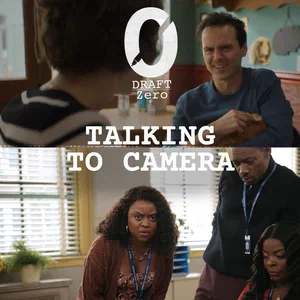
How is the effect of breaking the 4th wall different to voiceover?
AI✦Mel and the crew use the craft tools and levers identified in previous episodes to examine specific scenes from HIGH FIDELITY, ABBOTT ELEMENTARY, and FLEABAG, treating fourth-wall breaking as one tool among many.✦
Listen to understand how breaking the 4th wall directly involves the audience in a character's emotional present.
▶
More Info
As part of our series on how filmmakers can directly communicate to the audience, we finally examine the most blatant tool of them all: when character look directly down the barrel of the camera… and thus look directly at
us, the viewer. Chas, Stu and Mel take the craft tools/levers they identified in previous episodes and use them to examine the tv-version-of HIGH FIDELITY (“Top Five Breakups”), ABBOTT ELEMENTARY (“Attack Ad)”) and - of course - FLEABAG…
→
What can and should you do next?
AI✦The episode offers practical, experience-based tools for navigating spec work versus work-for-hire contexts and adapting your writing style accordingly.✦
Listen to understand what you can control in your career--and what you absolutely cannot.
▶
More Info
In our annual Backmatter-only episode, Stu and Chas indulge themselves by offering personal opinions on the life and work of emerging screenwriters based on their own personal experience…
→
How can you best articulate your ideas?
AI✦Stu and Chas discuss their evolving toolkit and process, showing how screenwriters build and refine the instruments they use to solve problems on the page.✦
Listen if you need to forgive yourself (for not writing)
▶
More Info
It is time (in fact, well past time) for our semi-annual #Backmatter episode. For the uninitiated, this is an episode where Stu and Chas discuss career and craft-related topics beyond what makes great screenplays work. To that end, Stu and Chas dive into: a five year review of Draft Zero and how it has changed their writing craft and process; a discussion on the aesthetics of writing; learnings for emerging writers in having their work produced; and finally forgiving yourself for not writing…
→How does splitting 'character functions' enhance theme?
AI✦Chas and Stu offer character function splitting as a concrete craft tool for writers deciding how to structure their ensemble and reinforce thematic intent through structural choices.✦
Listen to see how splitting character functions across your cast sharpens what your story actually means.
▶
More Info
We are often told that our ‘protagonist’ needs to be a active. That they need to be compelling. That they need to change. And - old faithful - that they need to be likeable. But after looking at MAD MAX: FURY ROAD, STAR TREK (2009), THE FIGHTER, and SICARIO, Chas and Stu learn that your primary character does not need to do
all these things. In fact, they learn that splitting these functions between your primary characters can reinforce theme and create potential for different types of narratives…
→
Are there screenwriting lessons to be taken from analysing the work of Michael f-ing Bay?
AI✦Bitter Script Reader presents Bay’s filmography as a toolkit for emerging screenwriters seeking to understand how one of cinema’s most successful directors executes his fundamental storytelling decisions.✦
Listen to understand how one of the world's highest-grossing directors structures story, makes great villians, controls information flow, and makes visual decisions on the page
▶
More Info
Of course there are. How could there not be? After all, Michael Bay is the 3rd highest grossing director at the worldwide box office... of all time. Behind, y’know, Spielberg and stuff. How could a man of such credentials not know story? Or, so argues this week’s guest: the author of MICHAEL F-ING BAY: THE UNHERALDED GENIUS IN MICHAEL BAY’S FILMS... [drumroll]... the Bitter Script Reader…
→
When you're an emerging filmmaker, what are different ways to tackle a "career"?
AI✦Rather than dissecting a specific screenplay, Chas and Stu use this holiday special to step back and discuss the conceptual tools and approaches that have defined their first year of podcast and creative work.✦
Listen when you're deciding between shorts, features, and web content--and need to know which format actually builds a sustainable creative practice.
▶
More Info
It’s our Holiday Special! In this episode (recorded December 2014), Chas and Stu break all the rules. No homework. No pages. No empirical analysis. They reluctantly but boldly reflect over the first year of Draft Zero and how it has influenced their ‘careers’ (such as they are). They also engage in a heated debate on whether a short film, a micro-budget feature or web-based content is the best way to go in terms of pushing a filmmaking career forward…
→