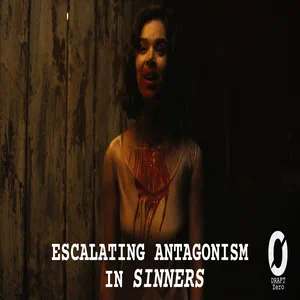
"So I think that’s what’s kind of interesting about this idea. The transgression actually kind of goes both ways. For an action movie, because what we’re talking about is Awaking the Horror. For the characters in a movie like Rebel Ridge, which is an action movie, the monster is kind of the lead character as well."
— Stu Willis | DZ-121: Escalating Antagonism in SINNERS
Start here

How can characters be their own antagonist?
AI✦Chas and Stu’s central thesis--that antagonistic forces carve out the protagonist’s journey--reframes how antagonism operates beyond a singular opposing character.✦
Listen if you want to understand how protagonists can serve as their own antagonist and how antagonistic forces shape a character's journey
▶
More Info
In Part Two of our Five Part Epic Exploration™ into antagonists, Chas & Stu take a look at “vs self” stories. Stories where the protagonist (or main character) serves as their own antagonist as well as the antagonist for those around them…
→

What changes in your story if your antagonistic forces can't be bargained with?
AI✦Chas and Stu distinguish between antagonistic forces that make choices versus those that don’t, fundamentally reshaping how conflict operates when your antagonist cannot be bargained with or reasoned into submission.✦
Listen to understand why pressure--not obstacles--is what transforms a protagonist when they face an unstoppable force.
▶
More Info
In this Part Three of our Five Part Epic Exploration™ into antagonistic forces (and sources of conflict), Chas & Stu explore “nature” antagonists, including some supernatural ones. What became clear in doing the homework (and recording this episode
twice) was that the antagonistic forces - whether natural or supernatural - presented different narrative challenges to the protagonists if (a) they did not seem to make choices and (b) could not be bargained with or defeated…
→

How do systems pressure your characters to change?
AI✦The episode builds a sophisticated toolkit for understanding system/world/society antagonists as distinct pressure sources--obstacles, enablers, pushers, and pullers--that function as antagonistic forces independent of a traditional villain.✦
Listen if you want to use how societal, governmental, or environmental forces as villains.
▶
More Info
This is Part Four (!!) of our Five Part Epic Exploration into antagonists forces and sources of conflict. In this episode we explore “system/world/society” antagonists. While stereotypically associated with science-fiction, these sources of conflict are found across genres…
→

What if there is no antagonist?
AI✦Stu and Chas use these five films to prove that antagonism doesn’t require a singular antagonist -- it can be the film itself actively working against audience expectations.✦
Listen to turn narrative uncertainty itself into the engine that keeps viewers compelled.
▶
More Info
It’s time. The Epic Deep Dive(TM) into Antagonists has reached its shuddering conclusion. And for this Part V - by choosing films that have no obvious singular antagonist (and in some cases no obvious narrative either) - Stu and Chas realised there was indeed a final category of antagonists: the films themselves. Where the film (and the filmmaker) are engaging directly with the audience. Where the films are... VERSUS AUDIENCE…
→
KEY IDEAS
Multiple Aligned Sources of Antagonism
"MEET THE PARENTS is more simple than Rebel Ridge or Sinners that has clear contrasting and conflicting sources of antagonism. This has multiple sources of antagonism, but they're all aligned in what they're trying to do."
— Chas Fisher
(01:14:31)
· DZ-122: Escalating Antagonism Across Genres
Multiple Antagonistic Forces Aligned
"And in that way, it's more simple than Rebel Ridge or Sinners that has clear contrasting and conflicting sources of antagonism. This has multiple sources of antagonism, but they're all aligned in what they're trying to do."
— Chas Fisher
(01:14:31)
· DZ-122: Escalating Antagonism Across Genres
TOMBS As Generative Development Tool
"I think by us learning about this paradigm, it will help us in that development stage of stories. [...] we can actually look at the forces of antagonism in a story."
— Chas Fisher
(00:01:21)
· DZ-121: Escalating Antagonism in SINNERS
Beyond Protagonist: Examining Antagonistic Forces
"when you use those structures that are out there, they tend to be around plot and they tend to think primarily from the protagonist's point of view. And using this system, we can actually look at the forces of antagonism in a story."
— Chas Fisher
(00:06:31)
· DZ-121: Escalating Antagonism in SINNERS
The Hero as Monster in Action
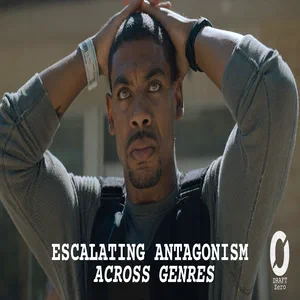
"So I think that's what's kind of interesting about this idea. The transgression actually kind of goes both ways. For an action movie, because what we're talking about is Awaking the Horror. For the characters in a movie like Rebel Ridge, which is an action movie, the monster is kind of the lead character as well."
— Stu Willis
(00:11:00)
· DZ-121: Escalating Antagonism in SINNERS
Even More

How can you apply horror ideas to action and comedy?
AI✦Stu, Chas, and Kim use TOMBS to reveal how antagonistic forces work across genres--showing that thinking of your hero as the horror for your villains creates dynamic escalation in action, horror, and comedy alike.✦
Listen to learn how thinking of your hero as the horror (for your villains) makes your script dynamic.
▶
More Info
In this episode Chas, Stu and guest Kim Ho continue their exploration into the power(s) of antagonism and how focusing on them can develop story…
→

How do the antagonistic forces in your story escalate distinctly from the protagonists' journey?
AI✦Chas argues that most story structures focus on the protagonist’s plot, but TOMBS lets you map the rising power of antagonistic forces separately--which is what generates narrative fuel and makes your second act sing.✦
Listen to strengthen your story by focusing on the antagonistic forces in your script.
▶
More Info
We often struggle to develop the middle stages of a story. Could this be because we focus on our protagonists’ journeys and plot structure more than on how the antagonistic powers are awakened, wronged, discovered, gathering strength and revealing themselves…
→

What makes a strong human antagonist?
AI✦Stu and Chas structure this entire episode around the foundational question of what makes a human antagonist work, using Die Hard, Misery, and Three Billboards to demonstrate how antagonistic forces operate through direct opposition.✦
Listen if you want to understand how to craft compelling antagonists who oppose your protagonist through direct human conflict
▶
More Info
Prompted by a listener (and patron of the podcast) question, Stu and Chas dive into antagonistic forces. And because Draft Zero does not do anything by halves, this is Part One of a Five Part Epic Exploration™ into antagonists; namely: vs humans, vs self, vs nature/supernatural, vs systems and “other”. aka the classic narrative conflicts…
→

Can one scene be the key to unlocking the whole story?
AI✦The dynamic between protagonist and antagonist in these key scenes is what generates the story’s forward momentum and thematic weight.✦
Listen if you want to understand how a single key scene between protagonist and antagonist can unlock the entire structure of your story!
▶
More Info
Can one scene be the key to unlocking the whole story…
→