2026
How does Film Noir show us terrible people doing terrible things without endorsing it?
AI✦Easy’s realization that ’the system doesn’t just not serve me, it is out to get me’ and Woman of the Hour’s parallel between 1970s predation and modern systems that fail victims show how noir’s worldview shapes what characters do and why audiences understand them.✦
Listen if you need audiences to root for characters who do terrible things
▶
More Info
Mel and Chas continue to explore what Noir (the genre) can teach writers of all other genres. In particular:…
→
2025
"It’s just tactics and fear. It is how are you trying to get what you want and what are you willing to reveal to the people in the room."
— Tom Vaughn | DZ-120: Subtext is Overrated!
What can Film Noir teach us about character arcs and audience engagement?
AI✦Mel frames The Long Goodbye as Marlowe starting with a genuine belief in good people but ending more jaded, suggesting his worldview shifts from optimism to pragmatism given the circumstances he encounters.✦
Listen if you want to write morally compromised characters without endorsing their choices.
▶
More Info
In this two part series, Mel and Chas use Noir (the genre) as a lens to interrogate flawed characters. How can characters doing reprehensible things still engage audiences? How can you ensure representation isn’t endorsement? And whether these characters undergo transformative arcs, or simply reveal their true natures…
→
How do character goals, tactics, and fears create subtext automatically?
AI✦The group connects subtext to emotional truth, arguing that the gap between what characters say and what they feel--their fear of revealing themselves--is where the real drama lives.✦
Listen if you're struggling to write subtext without it feeling forced!
▶
More Info
Or, how focusing on good drama will result in good subtext. We often hear how subtext is important for good screenwriting. We’re here to tell you it isn’t. Good subtext is a result of good drama, and your focus should be on creating that good drama. But how…
→
How do you dramatise a protagonist's internal journey through their final decision?
AI✦Both Michael Clayton and Promising Young Woman withhold the complete experience of the final choice to speak more toward theme, with Chas and Stu arguing that theme questions are character questions dramatized in the ending.✦
Listen if you want to understand how to better dramatise a character's internal journey
▶
More Info
In this episode, Stu and Chas focus
solely on the final choices made by protagonists and how that reflects their character journey and successfully, or not, dramatises the internal…
→
2024
"Because I would say this film is actually more talking directly to the audience than Adaptation. Adaptation is more meta in the sense that it’s about the writing process. But I think this is more directly talking to the audience from the filmmaker’s perspective."
— Stu Willis | DZ-113: Tools For Filmmakers To Talk To The Audience
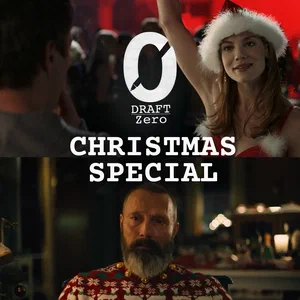
What magic do Christmas movies use to make them so rewatchable?
AI✦Damien Cassar connects nostalgia and the ‘pain of homecoming’ to how holiday films provide comfort and belonging, grounding the entire discussion in emotional authenticity rather than surface sentiment.✦
Listen if you want to understand what makes holiday films enduring parts of our seasonal rituals!
▶
More Info
In this “backmatter” episode of Draft Zero, Stu, Chas, and Mel Killingsworth embark on a festive exploration of what makes holiday films so engaging and so re-watchable that they can become part of our rituals. To that end, we breakdown the charm of of Christmas films like KISS KISS BANG BANG, RIDERS OF JUSTICE, and IT’S A WONDERFUL LIFE…
→

How does ending your story on the climax affect audience experience?
AI✦Chas and Mel trace how the decision to cut at the climax--and what gets shown versus what gets written--directly impacts the perceived theme of the film and what the story ultimately says.✦
Listen to understand how withholding resolution can make your story great!
▶
More Info
While Stu is on show, Mel and Chas sit down to analyse the meaning behind the ending of 2024’s CHALLENGERS, especially when - upon reading the script - the most impactful moment of the ending on screen (for Chas in particular) is not written on the page…
→
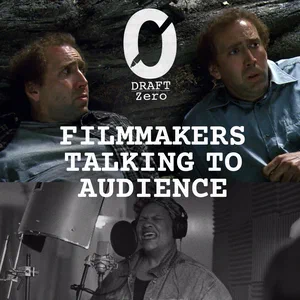
What tools help ensure that you as the filmmaker are not misunderstood?
AI✦The three films analyzed demonstrate how directorial hand and authorial presence become visible through unconventional narrative structures that break traditional storytelling conventions.✦
Listen if you want to explore how you can make your creative hand visible through meta-storytelling and structural choices!?!
▶
More Info
In our final (ha!) episode looking at Talking Directly to the Audience, we turn away from character-and-text based craft tools to look at other ways that filmmakers - whether they be directors, writers, editors, or anyone else - can make the audience feel their ‘hand’ more. To that end, Mel, Stu and Chas dive into ADAPTATION, STORIES WE TELL and THE FORTY-YEAR-OLD VERSION…
→
2023
"What I’m constantly trying to do is just tell the story in a bunch of different ways as it slowly gets more and more embellished. [...] A prose version of the story, particularly with a feature, can give you an idea of, is this flowing as a narrative?"
— Stu Willis | DZ-106: How do you know if you have enough story?
How do you know if you have enough narrative fuel to write a script?
AI✦Both Chas and Mel stress that knowing your theme before you start any formal development work is essential -- Chas won’t even begin plotting until he knows how it ends and what he’s exploring thematically.✦
Listen you're not sure whether your idea has enough fuel for 90 pages.
▶
More Info
In this episode, Chas, Stu and Mel attempt to answer a listener question:
“In your own pre-writing process, how do you know you have enough for a feature? And do you have a specific pre-writing method you’re going to?”…
→
What effect does adding a ton of characters have on your story?
AI✦The discussion contextualizes how adding multiple storylines and characters ultimately serves a film’s thematic purpose, showing the relationship between ensemble size and thematic expression.✦
Listen if you're writing an ensemble storiy and want to understand how different characters serve different narrative and thematic functions!
▶
More Info
In Part 3 (the final part? Ha!) of our exploration into ensemble stories, Stu, Chas & Mel examine films whose genres do not conventionally require a ton of characters or that use those ensembles in unconventional ways. In particular, adding whole storylines that are separate from the main character’s story. To that end, we dive into three films that were horrifically snubbed by the Oscars: THE WOMAN KING, RIDERS OF JUSTICE and NOPE…
→
How can the same story feel different when you have more characters?
AI✦By asking why the distinction between ensemble and single-protagonist stories even matters, the hosts engage with underlying principles of how narrative architecture shapes audience experience.✦
Listen if you're working on a story with multiple protagonists and want to understand what makes an ensemble different from a single-protagonist narrative
▶
More Info
In the first part of our series on ensembles, Chas, Stu and Mel start by laying the groundwork for our future episodes. And we begin by asking the seemingly innocuous question:
What do we mean by calling a story an ensemble?…
→
2022
How can dramas use genre elements to hook their audiences?
AI✦Kodie Bedford and the hosts identify how thematic intent--what each film is actually about beneath its genre skin--shapes the gradual pivot away from genre obligations.✦
Listen if you're writing a genre film but sense your story wants to become something else entirely.
▶
More Info
Stu and Chas reunite with TV writer & director Kodie Bedford to look at how some films start out as genre but gradually become character dramas. Or, as Stu never said on the episode
“Genre in the streets, Drama in the sheets”.…
→
How do you deliver on the emotional contract of a genre while surprising the audience?
AI✦Each of the films discussed uses thematic depth to transcend genre formula, with Kodie, Stu, and Chas identifying how theme becomes the engine that makes genre storytelling feel necessary rather than obligatory.✦
Listen when you're writing within a genre but terrified you'll deliver something your audience has already seen.
▶
More Info
In tackling this enormous topic, Stu and Chads enlist professional TV writer and director Kodie Bedford, someone who has somehow managed to defy genre pigeon-holing by writing mystery, comedy and vampire shows…
→
2021
What can screenwriters learn from the storytelling techniques used by stand-up comedians?
AI✦Alice Fraser’s Masters in Narrative Rhetoric grounds the discussion in how stand-ups construct thematic power through the rhetorical triangle--logos, ethos, and pathos--making thematic resonance the backbone of what makes a comedy set emotionally gripping.✦
Listen if you want to understand how stand-up comedians grip audiences and build emotional arcs (and what narrative tools screenwriters can borrow from comedy)!
▶
More Info
Standup comedians can keep audiences gripped to their every word for over an hour, and often bring them to emotional climaxes by the end. So how do they do it and what tools can apply to scripted narratives…
→
2020
What can we learn from folk horror?
AI✦Rather than exploiting shock for its own sake, Aster grounds the film’s transgressive moments in authentic emotional logic--the ritualistic violence emerges from grief, not spectacle.✦
Listen if you want to understand how folk horror works as a genre and how Ari Aster uses it to explore grief and toxic relationships
▶
More Info
Draft Zero return with their next YouTube livestream! Stu and Chas are joined by previous guest (and successful screenwriter) C.S. McMullen for a deep dive into MIDSOMMAR! We analyse the film through the lens of Folk Horror, but tackle broader topics such as horror vs dread, rising tension, transgressions, unfilmables, and portraying toxic relationships…
→
How can I develop my theme without writing script pages?
AI✦Stephen Cleary and the hosts use concrete development tools to help writers understand how theme operates in their story before writing pages.✦
Listen tolearn concrete tools for developing theme in the early stages of your writing.
▶
More Info
Continuing our look at tools used in development, Chas & Stu are joined by Stephen Cleary to talk about
Theme,
The Thematic Logline and what Stephen calls
The Story Synopsis. All are tools to help writers better understand their theme and how it is dramatised. We use the classic film WITNESS as an example, so spoilers abound…
→
2019
How can unfilmables help you create those cinematic moments of awe?
AI✦By asking whether cinematic moments of awe are actually unscriptable, Chas and Stu examine the underlying philosophy of what makes certain sequences feel transcendent and how that effect can be engineered through writing.✦
Listen if you're writing a moment that feels too big for the page (but you need it on the page).
▶
More Info
In this second part of our series on unfilmables, Chas and Stu continue their deep dive into how writing the “unfilmable” can enhance your script. Rather than looking at micro moments, they turn their gaze to
“moments of awe” — those often breathtaking cinematic moments that feel
beyond writing. But are those scenes actually unscriptable…
→
How can you best articulate your ideas?
AI✦The episode centers on aesthetics as a foundational question--what makes writing good, and how do writers develop and articulate their aesthetic judgment.✦
Listen if you need to forgive yourself (for not writing)
▶
More Info
It is time (in fact, well past time) for our semi-annual #Backmatter episode. For the uninitiated, this is an episode where Stu and Chas discuss career and craft-related topics beyond what makes great screenplays work. To that end, Stu and Chas dive into: a five year review of Draft Zero and how it has changed their writing craft and process; a discussion on the aesthetics of writing; learnings for emerging writers in having their work produced; and finally forgiving yourself for not writing…
→
2018
How does removing character and plot question force your audience to engage with theme?
AI✦By removing character and plot questions altogether, filmmakers create space for thematic questions to become the primary driver of audience attention and interpretation.✦
Listen if you want to make theme your primary driver (for a sequence)
▶
More Info
Chas and Stu are joined, once again, by the inestimable Stephen Cleary. This episode is a spiritual sequel to our last episode with Stephen, the one on sequence structure. That episode explored how sequences could be broken into plot, character, and plot/character sequences…
→
How do systems pressure your characters to change?
AI✦By anchoring all character choices to their relationship with the system itself, the episode shows how thematically strong stories emerge when protagonist agency is measured against worldview and societal pressure.✦
Listen if you want to use how societal, governmental, or environmental forces as villains.
▶
More Info
This is Part Four (!!) of our Five Part Epic Exploration into antagonists forces and sources of conflict. In this episode we explore “system/world/society” antagonists. While stereotypically associated with science-fiction, these sources of conflict are found across genres…
→
What changes in your story if your antagonistic forces can't be bargained with?
AI✦Chas highlights how nature antagonists can mirror the protagonist and reinforce theme, using the antagonistic force itself as a thematic statement rather than merely an obstacle to overcome.✦
Listen to understand why pressure--not obstacles--is what transforms a protagonist when they face an unstoppable force.
▶
More Info
In this Part Three of our Five Part Epic Exploration™ into antagonistic forces (and sources of conflict), Chas & Stu explore “nature” antagonists, including some supernatural ones. What became clear in doing the homework (and recording this episode
twice) was that the antagonistic forces - whether natural or supernatural - presented different narrative challenges to the protagonists if (a) they did not seem to make choices and (b) could not be bargained with or defeated…
→
Can your characters be given choices and yet still be deprived of agency?
AI✦Chas, Stu, and CS connect the film’s lack of agency--particularly the absence of choices with different outcomes--to troubling depictions of women and minorities in the narrative.✦
Listen to discover how characters can be dramatised through binary choices (and understand the difference between choice and agency).
▶
More Info
To kick off 2018, Chas and Stu take a deep dive into one of their favourite movies of 2017: Blade Runner 2049. However, they abstained from “Fox News-ing this shit” by being joined by the most accomplished screenwriter they know, C.S. McMullen (Blood List 2017, Black List 2017, also a lover of Blade Runner 2049)…
→
Will Director Stu allow Writer Chas on his set?
AI✦The episode uses The Last Jedi to discuss how a story’s overall worldview and thematic position emerge through character choices and their ramifications.✦
Listen to understand how consequences (not intentions) impact whether an audience roots for or against your protagonist.
▶
More Info
Following our annual wrap up in 2017, we’ve decided to once again explore what craft issues/lessons we can garner from the latest Stars, namely Episode VIII: The Last Jedi, focusing on how consequences of character actions can do a lot of heavy lifting as to how the audience perceives that character (as well as looking at worldview and overall story structure)…
→
2017
How can you dramatise your theme on a scene level?
AI✦Stu and Chas directly examine how thematic concerns can be dramatised within individual scenes, using films with particularly strong and consistent themes as case studies.✦
Listen to discover how a character's worldview becomes the engine of conflict inside a single scene.
▶
More Info
As part of their ongoing exploration of scene-work, Stu and Chas apply their earlier thinking on theme and character worldview to individual scenes. Can examining a scene from a thematic perspective impact the drama, conflict or stakes of the scene? How does your character’s conscious and subconscious world views dramatise the overall theme of the work? How can an individual scene reflect the larger themes of the overall story? Do any of these questions or approaches lead to writing better scenes…
→
What screenwriting lessons can be we learn from SPLIT?
AI✦SPLIT offers a very clear example of how a film’s worldview and the rules of its world work together to create a coherent thematic statement.✦
Listen when you're writing a twist and need to earn it through point-of-view rather than surprise alone.
▶
More Info
In our first (and perhaps last) one-shot, we take a close look at the M. Night Shyamalan’s SPLIT. Rather than having one topic with many examples, we use the one example to look at many topics. Well, okay, a few topics…
→
How can your characters' worldview dramatise your theme?
AI✦Stu and Chas make the case that a character’s worldview is the engine that dramatises your theme, and they track how pilots use opening and closing scenes to establish what each protagonist believes about the world.✦
Listen if theme feels abstract - we talk how how to make it visible through what characters believe.
▶
More Info
In this episode, Stu and Chas tackle one of the more esoteric topics in screenwriting (and writing in general): theme! To help us tackle this topic, we decided to look at television pilots, because we felt that television requires the theme to be more explicit. Our zig-zagging (and long) discussion covers thematic engines, music themes, thematic loglines, punishment vs reward, and - perhaps most of all - the worldview of characters…
→
2016
How can writers wisely invest their time in projects?
AI✦Stu and Chas discuss how to approach exploring tone and theme as potential future episode topics, signaling that thematic work deserves dedicated craft attention.✦
Listen if you're juggling multiple projects and can't figure out which one deserves your attention right now.
▶
More Info
In this “special”, backmatter-only episode, Stu & Chas take inspiration from Terry Rossio’s excellent article on TIME RISK and ice skate over a range of topics. We talk about time investment in projects, Stuart’s project Restoration, doing you down work first, managing feedback, thinking positive being a negative, and we open the listener mail bag for critiques, praise and suggestions. We also explore how we could do Draft Zero episodes exploring tone and theme…
→
How does splitting 'character functions' enhance theme?
AI✦The entire episode frames character function splitting as a thematic tool--choosing which character does what serves the story’s central meaning, as demonstrated across MAD MAX: FURY ROAD, STAR TREK, THE FIGHTER, and SICARIO.✦
Listen to see how splitting character functions across your cast sharpens what your story actually means.
▶
More Info
We are often told that our ‘protagonist’ needs to be a active. That they need to be compelling. That they need to change. And - old faithful - that they need to be likeable. But after looking at MAD MAX: FURY ROAD, STAR TREK (2009), THE FIGHTER, and SICARIO, Chas and Stu learn that your primary character does not need to do
all these things. In fact, they learn that splitting these functions between your primary characters can reinforce theme and create potential for different types of narratives…
→
What makes a script so compelling that it ends up with an Oscar nod?
AI✦What makes these screenplays stick, according to Chas and Stu, is their commitment to emotional truth over plot convenience--a principle they trace through both films.✦
Listen to learn how catharsis, world-building, mid-points, and status transactions elevate great writing
▶
More Info
In this episode Stu and Chas return to their first ever episode by tackling two Oscar-nominated screenplays. But this time - instead of exploring the rigid structures laid down by gurus - they use it as an opportunity to explore what they’ve learned in the last three years and apply them to the phenomenal writing in SPOTLIGHT and CAROL (with slight digression towards THE EXPANSE and GAME OF THRONES (which has possibly replaced Star Wars as the de facto reference point for anything.)…
→
2015
Can screenplay competitions be worth it?
AI✦The episode gathers voices from judges, repeat competition attendees, and winners to present multiple perspectives on whether competitions accurately represent a writer’s work and potential to industry gatekeepers.✦
Listen if you're considering entering a screenplay competition and want to hear from writers and industry professionals about whether it's a worthwhile investment!
▶
More Info
After being repeatedly asked by listeners for thoughts on screenplay competitions, Stu and Chas go full back matter for this special episode. They tackle the question - do comps just feeding the hope machine or are they a valid investment? - in their typical detailed (i.e. long) style. With their differing perspectives, Stu (a director looking for material) and Chas (a writer keen for exposure), talk to an impressive roster of guests. We start with Gordy Hoffman, founder and judge of the Bluecat Screenplay Competition; repeat Austin Film Festival attendees - first for the screenplay and now for the finished web series of EX BEST - Diana Gettinger & Monica Hewes; Launchpad 2014 finalist Tony Pitman; and Insite Competition winner Blake Ashford, whose winning script CUT SNAKE hit cinemas in 2015... ten years after winning the competition…
→
How do screenwriters get away with using coincidences in their stories?
AI✦The episode wrestles with what makes a contrived moment feel satisfying or earned rather than cheating, which is fundamentally a question about taste and craft judgment in storytelling.✦
Listen when you need to know which coincidences earn trust and which ones feel like cheating.
▶
More Info
Remember that time in THE DARK KNIGHT RETURNS when Bruce suddenly - magically - returned to Gotham, and you were like “WTF?!” Well, it turns out that many of the best films have moments that are just as coincidental or contrived (or a flock of Giant Eagles) and yet get away with it. Does Pixar’s “rule” that it is ‘cheating to use coincidences to get your characters out of trouble’, always apply…
→
Are your story rules in your pilot strong enough to play out over the life of your show?
AI✦Chas and Stu identify how the thematic DNA of each show--corruption in THE SHIELD, systemic failure in THE WIRE, transformation in BREAKING BAD--gets encoded in the pilot’s dramatic rules and paid out over seasons.✦
Listen if you wanna know great television pilots establish the dramatic, literary, and cinematic rules that sustain their entire run.
▶
More Info
Stu and Chas move away from the world of features and dive into the Pilot Episodes of some (New) Golden Age Television: THE SHIELD, THE WIRE, BREAKING BAD, and MAD MEN. And we sneak in some discussion about ANGEL, THE SOPRANOS and GAME OF THRONES…
→
How can scene transitions do more than just move from one location to another?
AI✦By analyzing SCOTT PILGRIM, HIGHLANDER, AMERICAN SPLENDOR, and BOYHOOD, the hosts show how transitions actively enhance thematic connections between scenes rather than simply bridging them.✦
Listen to understand how transitions compress time, enhance thematic connections, unify story threads, and orient your reader
▶
More Info
Stu and Chas look at one of the basic building blocks of a script: scene transitions. Transitions don’t just move you from one scene to another in a slick way, they can help you compress time, enhance thematic connections, unify different story threads, orient (or disorient) your reader... and just make your script feel more like a movie… →
How can the Trinity Syndrome help you write better secondary characters?
AI✦The episode applies critical lenses--the Bechdel Test and Trinity Syndrome--to interrogate how mainstream cinema represents and fails to represent female secondary characters with substantive narrative roles.✦
Listen when you're writing secondary female characters and need them to have more depth.
▶
More Info
Chas & Stu are joined by Bamboo Killer (aka Emily Blake) - one of the co-hosts of the
Chicks Who Script podcast. They take a critical look at secondary female characters in mainstream movies through the lens of the oft-cited Bechdel test and the new, less-cited, Trinity Syndrome. The Trinity Syndrome berates movies for creating a
“Strong Female Character With Nothing To Do” (like Trinity in the Matrix sequels) and raises a list of questions for filmmakers to ask themselves about their (female) characters…
→
When you're an emerging filmmaker, what are different ways to tackle a "career"?
AI✦Breaking format to share personal reflections on their own careers, Chas and Stu prioritize candor about the real challenges and rewards of emerging filmmaking over theoretical abstraction.✦
Listen when you're deciding between shorts, features, and web content--and need to know which format actually builds a sustainable creative practice.
▶
More Info
It’s our Holiday Special! In this episode (recorded December 2014), Chas and Stu break all the rules. No homework. No pages. No empirical analysis. They reluctantly but boldly reflect over the first year of Draft Zero and how it has influenced their ‘careers’ (such as they are). They also engage in a heated debate on whether a short film, a micro-budget feature or web-based content is the best way to go in terms of pushing a filmmaking career forward…
→
2014
"We’re not here to give you a study guide. It’s not like music where it’s going to be Let’s do Grade One screenwriting. Let’s do Grade Two screenwriting. Not like that, unfortunately."
— Stu Willis | DZ-0: Welcome to Draft Zero
Is the MacGuffin truly interchangable, and how does it impact on your character writing?
AI✦What makes RAIDERS and THE CURSE OF THE BLACK PEARL work is that the MacGuffin connects to something the protagonist genuinely needs, not just something the plot requires him to find.✦
Listen to discover why the MacGuffin's emotional weight--not its function--determines whether your audience cares enough to follow the entire adventure.
▶
More Info
Stu and Chas are joined by a special guest - Scriptmag contributor Brad Johnson - to discuss how the choice of the MacGuffin can impact on the quality of an action/adventure film. To test this thesis, our heroes compare the auspicious originals of two iconic franchise with their, um, less-than-auspicious 4th instalments (in other words we compare RAIDERS OF THE LOST ARK with KINGDOM OF THE CRYSTAL SKULL and THE CURSE OF THE BLACK PEARL with ON STRANGER TIDES) as well as look at two recent & original entries into the genre, namely NATIONAL TREASURE and PRINCE OF PERSIA…
→
What can be gleamed from the substantial rewrite of a famed spec?
AI✦The substantial rewrite from BULLSHIT to HUSTLE involved thematic shifts that Stu and Chas trace through both scripts and the final film.✦
Listen to learn how impactful rewriting can be.
▶
More Info
Stu and Chas look at AMERICAN BULLSHIT (the 2010 Black List spec script by Eric Warren Singer) and the film it became… AMERICAN HUSTLE (co-written and directed by David O’Russell), which garnered 10 Oscar nominations in 2014…
→
What, exactly, is Draft Zero?
AI✦Stu frames Draft Zero’s core interest as narrative aesthetics--the effect of certain techniques on audiences--rather than formulas or structural prescriptions.✦
Listen if you're new to the podcast and want to understand our philosophy on screenwriting craft!
▶
More Info
Welcome to Draft Zero. A message from 2019 to those starting with our first episodes dating from 2014. We’ve learned a lot in five years. So where do you begin…
→