§ RESOURCES / FILM INDEX
Star Wars (1977)
Featured In
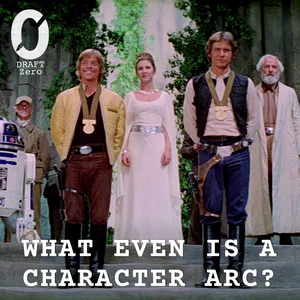
DZ-128: What even is a Character Arc?
What effect does character changing have on the audience?
AI✦Figures out why Luke wins by staying exactly who he was -- and how a story world can reward a character for refusing to change.✦
Listen to separate the three layers of an arc -- does the character change? How do they feel about it? And how is the audience positioned to feel about it?
▶ More Info
Stu, Chas and Mel finally begin their long-awaited journey into CHARACTER ARCS. In this “primer” episode, we try find some learnings and analytical lenses that we can then apply in future breakdowns… →
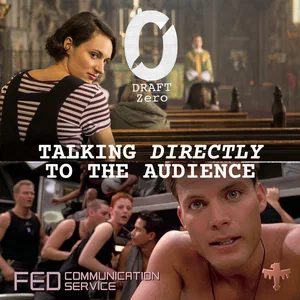
DZ-109: Talking DIRECTLY to your audience
What are the different ways a filmmaker can ask something of the audience?
AI✦Uses the famous opening sequence to demonstrate how filmmakers can pull the lever from diagetic storytelling toward non-diagetic exposition, asking the audience to accept information delivered by an unseen, unidentified narrator positioned outside the story world.✦
Listen if you've wondered what a character actually wants when they're talking directly to the audience!?
▶ More Info
What are the different ways a filmmaker can ask something of the audience… →
Films:
Fight Club (1999)
, Fleabag (2016)
, The Big Short (2015)
, F for Fake (1973)
, Star Wars (1977)
DZ-84: Choices & Decisions 1 - Booksmart
What is the difference between choice and decision when it comes to characters?
In order to better understand dramatising of character, Chas and Stu take a very draft zero look at very specific tool: choices and decisions. We analyse three films through the decisions made by their characters. In particular, how the audience understanding of: the choice available, the considered decision itself, and the consequence changes how we feel about these characters. And how separating those three things can create different emotional effects on your audience… →
Listen how the separation of choice, decision, and consequence (for a character) creates emotional impact.
▶ More Info
In order to better understand dramatising of character, Chas and Stu take a very draft zero look at very specific tool: choices and decisions. We analyse three films through the decisions made by their characters. In particular, how the audience understanding of: the choice available, the considered decision itself, and the consequence changes how we feel about these characters. And how separating those three things can create different emotional effects on your audience… →
Films:
Booksmart (2019)
, Se7en (1995)
, Star Wars (1977)
, The Farewell (2019)
, Wrath of Man (2021)
, Fleabag (2016)
Shows:
Fleabag
DZ-55: Character Motivations 1
What to do when a reader says "I don't buy that he/she would do that"?
Chas & Stu look at examples of good character motivation. We’ve all watched movies where we don’t believe the motivation of a character or characters. We may have even written scripts where readers don’t buy the character’s choices. And that’s often a real problem because most of these choices coincide with key structural moments — e.g. the moments where the characters decide to do something “out of character” in order to progress to the next part of the story. To help us solve the problem of how to improve our character motivations, in this episode we explore great examples of character motivation and how they have helped the audience believe a character’s decision… →
Listen if you're writing a scene where your character does something 'out of character' and your readers to buy it.
▶ More Info
Chas & Stu look at examples of good character motivation. We’ve all watched movies where we don’t believe the motivation of a character or characters. We may have even written scripts where readers don’t buy the character’s choices. And that’s often a real problem because most of these choices coincide with key structural moments — e.g. the moments where the characters decide to do something “out of character” in order to progress to the next part of the story. To help us solve the problem of how to improve our character motivations, in this episode we explore great examples of character motivation and how they have helped the audience believe a character’s decision… →
Films:
Arrival (2016)
, Notting Hill (1999)
, Blockers (2018)
, The Matrix (1999)
, Star Wars (1977)
, Game Night (2018)
DZ-10: Midpoint Reversals and The Ride
How can the middle of your film pivot so much that it pulls the rug out of your audience?
Stu and Chas embark on the first of a series of explorations into the dreaded Second Act. Their first stop is midpoint reversals or shifts, a plot point bang in the middle of ACT II that changes the protagonist’s goal, raises the stakes and potentially leaves your audience leaning forward and asking “How the hell is this going to end?&rdquo… →
Listen when your second act sags and you need a structural jolt to accelerate audience engagement.
▶ More Info
Stu and Chas embark on the first of a series of explorations into the dreaded Second Act. Their first stop is midpoint reversals or shifts, a plot point bang in the middle of ACT II that changes the protagonist’s goal, raises the stakes and potentially leaves your audience leaning forward and asking “How the hell is this going to end?&rdquo… →
Films:
Death at a Funeral (2007)
, Prisoners (2013)
, Short Term 12 (2013)
, Alien (1979)
, Aliens (1986)
, The Bourne Supremacy (2004)
, Full Metal Jacket (1987)
, Philomena (2013)
, How I Live Now (2013)
, Elysium (2013)
, Die Hard (1988)
, Star Wars (1977)
Referenced In
DZ-5
Shifting audience point of view and heightened emotions
⏱ 1h 29m
APR 2014
DZ-9
Characterising Introductions
⏱ 1h 22m
JUN 2014
DZ-10
Midpoint Reversals and The Ride
⏱ 1h 19m
JUL 2014
DZ-11
Adventure for the MacGuffin!
⏱ 1h 49m
JUL 2014
DZ-12
Craft, Career and Coffins
⏱ 1h 1m
SEP 2014
DZ-30
Oscars revisited - Spotlight and Carol
⏱ 1h 43m
FEB 2016
DZ-49
Antagonists! 1 - vs Humans
⏱ 1h 20m
MAR 2018
DZ-93
Talismans (Part 1)
⏱ 1h 37m
OCT 2022
Also on Shot Zero
- ↗ Week 78: LEGENDS Bonus Episode! 2024-07-11