
§ RESOURCES / TOPICS / World Building
World Building
Every episode covering World Building.
Start here
DZ-15: World Building Rules, Okay?
How does setting up rules help you build a world?
AI✦Chas and Stu argue that rules make something a world and not just a setting, using the opening 3-5 pages to establish how audiences learn to read the fictional reality of your story.✦
Listen when your opening pages feel like exposition dumps (which is bad, okay?)
▶ More Info
In our most epic/longest episode yet, Chas and Stu tackle world building in films. Specifically, how the rules make something a world and not just a setting. Starting with world-centric genres like sci-fi and fantasy, we also cover horror, crime drama and - er - “other”. We discuss a variety of techniques for setting up the rules of the world, including cold opens, voiceover, title cards and outsider characters! We’ve limited ourselves to the opening 3-5 pages... mostly... because (so the theory goes) they’re the pages that teach the audience how to read/watch your story/film… →
Films:
The Matrix (1999)
, Inception (2010)
, The Lord of the Rings: The Fellowship of the Ring (2001)
, Jurassic Park (1993)
, Pan's Labyrinth (2006)
Even More
DZ-52: Antagonists! 4 - vs Systems
How do systems pressure your characters to change?
AI✦Understanding a system antagonist requires understanding the rules and pressures that define the world--making world-building not decorative but structural to how conflict and character change unfold.✦
Listen if you want to use how societal, governmental, or environmental forces as villains.
▶ More Info
This is Part Four (!!) of our Five Part Epic Exploration into antagonists forces and sources of conflict. In this episode we explore “system/world/society” antagonists. While stereotypically associated with science-fiction, these sources of conflict are found across genres… →
Films:
Minority Report (2002)
, Dawn of the Planet of the Apes (2014)
, Mudbound (2017)
, The Lobster (2015)
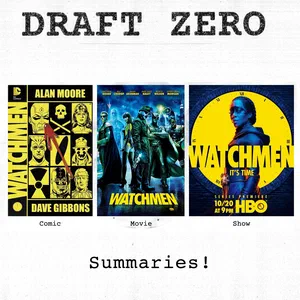
DZ-82: Dramatising Given Circumstances in WATCHMEN
How can you elegantly convey given circumstances and exposition?
AI✦Both WATCHMEN adaptations require extensive world-building -- alternate history, superhero rules, political systems -- and the podcast examines how writers elegantly convey these layers of world-specific information without overwhelming the audience.✦
Listen if you're drowning your readers in world-building and can't figure out how to make it awesome!
▶ More Info
In this final podcast release of last year’s run of LiveSoLation episodes, Chas and Stu are joined by Uber-geek Mel Killingsworth (who else?) in an epic exploration of how Dave Gibbons’ and Alan Moore’s seminal graphic novel WATCHMEN is adapted differently in Zack Snyder’s 2009 film and Damon Lindelof’s 2019 HBO television show… →
Shows:
Watchmen
DZ-81: Pitch Decks & Look Books - Development Tools 4
How do you make effective pitch decks and look books for your projects?
AI✦Lookbooks establish the visual world of a project, and Marc addresses how to construct and present that world across television versus features.✦
Listen if you're preparing to pitch a project and want to understand how to create compelling visual materials
▶ More Info
Chas and Stu are joined by writer/director/producer/multi-hyphenate Marc Furmie of Rezistor Studios to talk all things pitch decks and look books. Coming from an advertising and music video background, Marc shares his experience in putting together visual materials to pitch a project. We discuss the difference between pitch decks and lookbooks, how they help you sell your projects, what buyers are looking for, television vs features, and how do we make yours better… →
DZ-75: Fury Road & Visual Storytelling
How can you do powerful storytelling... without dialogue?
AI✦FURY ROAD teaches you a fully realized world through action and design rather than exposition--every vehicle, costume choice, and landscape detail communicates stakes and history.✦
Listen to hear how visual storytelling can carry an entire narrative with minimal dialogue.
▶ More Info
Stu and Chas are joined by filmmaker, podcaster and writer Lia Matthew Brownn to deep dive into FURY ROAD and its astounding visual storytelling, both on the page and on screen. We talk about setups and payoffs, given circumstances, image systems, environmental storytelling, and how the relationship between Furiosa and Max is built over the course of the story with very little dialogue (besides Tom Hardy’s grunts and the odd bellow of “MEDIOCRE!”).
You can also watch the complete live stream on YouTube or just the breakdown of the Furiosa/Max fight (which isn’t in the podcast) here: https://www.youtube.com/watch?v=f8uYAbEcQeQ&feature=youtu.be… →
Films:
Mad Max: Fury Road (2015)
DZ-74: Midsommar & Folk Horror
What can we learn from folk horror?
AI✦The episode examines how the Hårga community’s customs, calendar, and mythology create a fully realized world that operates by its own logic, making the horror feel inevitable rather than imposed.✦
Listen if you want to understand how folk horror works as a genre and how Ari Aster uses it to explore grief and toxic relationships
▶ More Info
Draft Zero return with their next YouTube livestream! Stu and Chas are joined by previous guest (and successful screenwriter) C.S. McMullen for a deep dive into MIDSOMMAR! We analyse the film through the lens of Folk Horror, but tackle broader topics such as horror vs dread, rising tension, transgressions, unfilmables, and portraying toxic relationships… →
Films:
Midsommar (2019)
DZ-37: Excelling at Exposition (Part 1)
How can you successfully integrate exposition into your story?
AI✦Several of the analyzed films establish complex fictional worlds with specific rules, and the episode breaks down how writers communicate those worldbuilding facts organically through character action and interaction.✦
Listen if your exposition scenes feel like information dumps disguised as dialogue.
▶ More Info
In Draft Zero’s first two part episode, Stu & Chas take an in-depth look at one of screenwriting’s most common challenges: EXPOSITION. For many stories there are pre-existing facts that need to be communicated to the audience — whether those facts be about the rules of the world, the nature of a location, character motivations, character backstories or just character names. So how have great writers made exposition move the story forward, rather than stopping it to tell the audience stuff they need to know… →
Films:
Pirates of the Caribbean: The Curse of the Black Pearl (2003)
, Short Term 12 (2013)
, Inside Out (2015)
, The World's End (2013)
, The Big Short (2015)
, It Follows (2015)
, Jurassic Park (1993)
, Jurassic World (2015)
DZ-30: Oscars revisited - Spotlight and Carol
What makes a script so compelling that it ends up with an Oscar nod?
AI✦The hosts analyze how deliberate world-building choices in these scripts create the texture and specificity that elevates them beyond standard narrative structure.✦
Listen to learn how catharsis, world-building, mid-points, and status transactions elevate great writing
▶ More Info
In this episode Stu and Chas return to their first ever episode by tackling two Oscar-nominated screenplays. But this time - instead of exploring the rigid structures laid down by gurus - they use it as an opportunity to explore what they’ve learned in the last three years and apply them to the phenomenal writing in SPOTLIGHT and CAROL (with slight digression towards THE EXPANSE and GAME OF THRONES (which has possibly replaced Star Wars as the de facto reference point for anything.)… →
DZ-24: Forging story rules in TV pilots
Are your story rules in your pilot strong enough to play out over the life of your show?
AI✦THE WIRE and THE SHIELD are examined for how they construct the rules of their worlds--institutional, political, moral--within the span of a pilot, establishing the landscape that the series will spend seasons exploring.✦
Listen if you wanna know great television pilots establish the dramatic, literary, and cinematic rules that sustain their entire run.
▶ More Info
Stu and Chas move away from the world of features and dive into the Pilot Episodes of some (New) Golden Age Television: THE SHIELD, THE WIRE, BREAKING BAD, and MAD MEN. And we sneak in some discussion about ANGEL, THE SOPRANOS and GAME OF THRONES… →