Subtext: The Meaning Beneath the Text
"Subtext is whatever text is going on beneath the text, so what we mean by text? We're talking about film and TV, what are the characters literally doing and saying, and is there any other meaning underneath that, beyond the literal, beyond what they're doing and saying?"
— Chas Fisher
(00:03:57)
· DZ-120: Subtext is Overrated!
Joke as Shield
"A joke is a shield between you and the audience. Or it can be a door between you and the audience. It can be an invitation and depends on how you use it. And I think certainly in Nanette, Hannah Gadsby has comments on the fact that she has been using jokes as a distancing mechanism, as a way to distance herself from her traumatic experience, a way of rewriting those traumatic experiences, a way of getting the dig in before other people do."
— Alice Fraser
(00:46:25)
· DZ-83: A Very Thematic Stand-up Special!
How do character goals, tactics, and fears create subtext automatically?
AI✦The group connects subtext to emotional truth, arguing that the gap between what characters say and what they feel--their fear of revealing themselves--is where the real drama lives.✦
Listen if you're struggling to write subtext without it feeling forced!
▶
More Info
Or, how focusing on good drama will result in good subtext. We often hear how subtext is important for good screenwriting. We’re here to tell you it isn’t. Good subtext is a result of good drama, and your focus should be on creating that good drama. But how…
→
What magic do Christmas movies use to make them so rewatchable?
AI✦Damien Cassar connects nostalgia and the ‘pain of homecoming’ to how holiday films provide comfort and belonging, grounding the entire discussion in emotional authenticity rather than surface sentiment.✦
Listen if you want to understand what makes holiday films enduring parts of our seasonal rituals!
▶
More Info
In this “backmatter” episode of Draft Zero, Stu, Chas, and Mel Killingsworth embark on a festive exploration of what makes holiday films so engaging and so re-watchable that they can become part of our rituals. To that end, we breakdown the charm of of Christmas films like KISS KISS BANG BANG, RIDERS OF JUSTICE, and IT’S A WONDERFUL LIFE…
→
What can screenwriters learn from the storytelling techniques used by stand-up comedians?
AI✦The episode examines how comedians in NANETTE, BABY COBRA, and INSIDE reach emotional climaxes by grounding their humor in authentic vulnerability and thematic honesty rather than just gags.✦
Listen if you want to understand how stand-up comedians grip audiences and build emotional arcs (and what narrative tools screenwriters can borrow from comedy)!
▶
More Info
Standup comedians can keep audiences gripped to their every word for over an hour, and often bring them to emotional climaxes by the end. So how do they do it and what tools can apply to scripted narratives…
→
What can we learn from folk horror?
AI✦Rather than exploiting shock for its own sake, Aster grounds the film’s transgressive moments in authentic emotional logic--the ritualistic violence emerges from grief, not spectacle.✦
Listen if you want to understand how folk horror works as a genre and how Ari Aster uses it to explore grief and toxic relationships
▶
More Info
Draft Zero return with their next YouTube livestream! Stu and Chas are joined by previous guest (and successful screenwriter) C.S. McMullen for a deep dive into MIDSOMMAR! We analyse the film through the lens of Folk Horror, but tackle broader topics such as horror vs dread, rising tension, transgressions, unfilmables, and portraying toxic relationships…
→
How can you best articulate your ideas?
AI✦Forgiving yourself for not writing is framed as essential to sustaining a writing practice, tying emotional honesty about the creative process to long-term craft development.✦
Listen if you need to forgive yourself (for not writing)
▶
More Info
It is time (in fact, well past time) for our semi-annual #Backmatter episode. For the uninitiated, this is an episode where Stu and Chas discuss career and craft-related topics beyond what makes great screenplays work. To that end, Stu and Chas dive into: a five year review of Draft Zero and how it has changed their writing craft and process; a discussion on the aesthetics of writing; learnings for emerging writers in having their work produced; and finally forgiving yourself for not writing…
→
What makes a script so compelling that it ends up with an Oscar nod?
AI✦What makes these screenplays stick, according to Chas and Stu, is their commitment to emotional truth over plot convenience--a principle they trace through both films.✦
Listen to learn how catharsis, world-building, mid-points, and status transactions elevate great writing
▶
More Info
In this episode Stu and Chas return to their first ever episode by tackling two Oscar-nominated screenplays. But this time - instead of exploring the rigid structures laid down by gurus - they use it as an opportunity to explore what they’ve learned in the last three years and apply them to the phenomenal writing in SPOTLIGHT and CAROL (with slight digression towards THE EXPANSE and GAME OF THRONES (which has possibly replaced Star Wars as the de facto reference point for anything.)…
→
When you're an emerging filmmaker, what are different ways to tackle a "career"?
AI✦Breaking format to share personal reflections on their own careers, Chas and Stu prioritize candor about the real challenges and rewards of emerging filmmaking over theoretical abstraction.✦
Listen when you're deciding between shorts, features, and web content--and need to know which format actually builds a sustainable creative practice.
▶
More Info
It’s our Holiday Special! In this episode (recorded December 2014), Chas and Stu break all the rules. No homework. No pages. No empirical analysis. They reluctantly but boldly reflect over the first year of Draft Zero and how it has influenced their ‘careers’ (such as they are). They also engage in a heated debate on whether a short film, a micro-budget feature or web-based content is the best way to go in terms of pushing a filmmaking career forward…
→
Is the MacGuffin truly interchangable, and how does it impact on your character writing?
AI✦What makes RAIDERS and THE CURSE OF THE BLACK PEARL work is that the MacGuffin connects to something the protagonist genuinely needs, not just something the plot requires him to find.✦
Listen to discover why the MacGuffin's emotional weight--not its function--determines whether your audience cares enough to follow the entire adventure.
▶
More Info
Stu and Chas are joined by a special guest - Scriptmag contributor Brad Johnson - to discuss how the choice of the MacGuffin can impact on the quality of an action/adventure film. To test this thesis, our heroes compare the auspicious originals of two iconic franchise with their, um, less-than-auspicious 4th instalments (in other words we compare RAIDERS OF THE LOST ARK with KINGDOM OF THE CRYSTAL SKULL and THE CURSE OF THE BLACK PEARL with ON STRANGER TIDES) as well as look at two recent & original entries into the genre, namely NATIONAL TREASURE and PRINCE OF PERSIA…
→

How do you dramatise a protagonist's internal journey through their final decision?
AI✦Promising Young Woman’s contingency plan--the package to the police in case of her death--does heavy lifting because it reveals what she actually believes about justice and her own fate without needing to show us the internal debate.✦
Listen if you want to understand how to better dramatise a character's internal journey
▶
More Info
In this episode, Stu and Chas focus
solely on the final choices made by protagonists and how that reflects their character journey and successfully, or not, dramatises the internal…
→
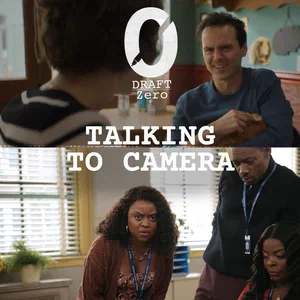
How is the effect of breaking the 4th wall different to voiceover?
AI✦Mel insists that what Fleabag tells us to camera--even if she’s lying to herself--doesn’t make it not real, positioning fourth-wall breaking as a craft tool for revealing emotional truth rather than factual accuracy.✦
Listen to understand how breaking the 4th wall directly involves the audience in a character's emotional present.
▶
More Info
As part of our series on how filmmakers can directly communicate to the audience, we finally examine the most blatant tool of them all: when character look directly down the barrel of the camera… and thus look directly at
us, the viewer. Chas, Stu and Mel take the craft tools/levers they identified in previous episodes and use them to examine the tv-version-of HIGH FIDELITY (“Top Five Breakups”), ABBOTT ELEMENTARY (“Attack Ad)”) and - of course - FLEABAG…
→
How does removing character and plot question force your audience to engage with theme?
AI✦When plot and character questions are removed, the audience connects directly to emotional truth rather than navigating forward momentum or internal conflict.✦
Listen if you want to make theme your primary driver (for a sequence)
▶
More Info
Chas and Stu are joined, once again, by the inestimable Stephen Cleary. This episode is a spiritual sequel to our last episode with Stephen, the one on sequence structure. That episode explored how sequences could be broken into plot, character, and plot/character sequences…
→

How can we teach our audience new storytelling rules in the middle of our story?
AI✦The tonal shift from humor to genuine emotion in Shaun of the Dead’s mother-death scene lands because the script has already taught the audience throughout the film that these moments will come, making the violence feel impactful and earned.✦
Listen if you want to write tonal pivots that land on the page without a director's toolkit.
▶
More Info
Following on from our episodes on
establishing tone through action lines and
through character, this is what we have been building up to: how to pull off a tonal switch… that does NOT throw the audience out of the film. And, in particular, how to pull that off on the page when writers don’t have framing, lighting, music, editing, etc. at our disposal…
→