"In some stories it’s really fascinating to watch how maybe one of the characters doesn’t really understand the situation they’re in. They don’t know they’re in a negotiation. They don’t realise they’re actually in an argument. They’re not aware they’re being broken up with, or literally, they’re not aware that they’re in a fight. And it’s watching how those different expectations are in conflict, not just the two people."
— Damon Young | DZ-100: Scenes through Swords
Placing the Ending First
"They could have put that opening at the end of the film, but I think the entire perception of that, like how compelling we would have found that 90 minutes would have been very different had they put that at the end. The way that you emotionally connect with those characters is going to be completely different depending on whether you're with them or whether you're ahead of them."
— Chas Fisher
(00:22:10)
· DZ-125: Oscars One-shot - BLUE MOON
Dramatic Irony Reignites Subtext
"Because she is completely incidental to what's going on in terms of the tactics of the people in the scene. Like Shoshana's tactic is, I need to say as little as humanly possible. And the other two are the ones with an objective. And it's only when Hans arrives in the scene that the subtext is reignited and it's just reignited pretty much through dramatic irony, through narrative point of view."
— Chas Fisher
(00:55:42)
· DZ-120: Subtext is Overrated!
Asymmetric Awareness
"In some stories it's really fascinating to watch how maybe one of the characters doesn't really understand the situation they're in. They don't know they're in a negotiation. They don't realise they're actually in an argument. They're not aware they're being broken up with, or literally, they're not aware that they're in a fight. And it's watching how those different expectations are in conflict, not just the two people."
— Damon Young
(00:52:39)
· DZ-100: Scenes through Swords
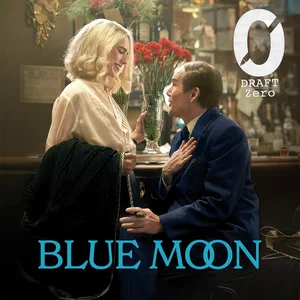
What craft tools make a low-budget, contained, period drama riveting?
AI✦The opening cards reveal Larry Hart’s death seven months ahead, which Chas argues transforms the entire 90 minutes: we’re always ahead of Larry, watching him move toward an ending he doesn’t know is coming, which makes the story more compelling than if we’d been left in suspense.✦
Listen if you want to understand how narrative POV, screenplay format, and dialogue craft can elevate a contained biopic into an Oscar-nominated film
▶
More Info
BLUE MOON is a talky, period-drama that film about an obscure songer-writer in the 1940s. Yet, it attracted world-class talent AND Academy Award nominations, including for it’s script. Join Chas & Mel as they explore how narrative POV, interweaving relationships, hooky dialogue, and even the screenplay format itself make the script for BLUE MOON so great…
→
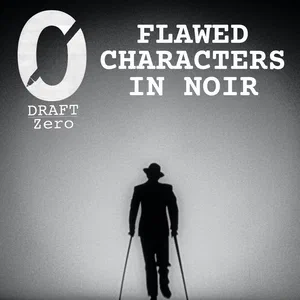
What can Film Noir teach us about character arcs and audience engagement?
AI✦Double Indemnity and The Long Goodbye both tip their hand to the audience from the opening--you know the transgression happened before the plot begins--which means you’re not watching to find out what occurred, but rather watching how the character’s own certainty that they’re smarter than they are leads them into the trap.✦
Listen if you want to write morally compromised characters without endorsing their choices.
▶
More Info
In this two part series, Mel and Chas use Noir (the genre) as a lens to interrogate flawed characters. How can characters doing reprehensible things still engage audiences? How can you ensure representation isn’t endorsement? And whether these characters undergo transformative arcs, or simply reveal their true natures…
→
How can shifting narrative point of view drive your sequences?
AI✦The episode hinges on how Rian Johnson withholds and reveals information to create gaps between what audiences and characters know, manufacturing suspense and recontextualization.✦
Listen to help you master the gap between what your audience knows and what your characters know.
▶
More Info
Born out of isolation madness, this episode is an edited version of Draft Zero’s first YouTube livestream. Stu and Chas both watched KNIVES OUT and - together with our listeners - broke down each sequence and turning point by reference to what the audience knows in relation to the characters (aka narrative point of view). They then answer listener questions on KNIVES OUT and much else besides live on air…
→
How does audience knowledge affect your character's motivations?
AI✦The episode hinges on the gap between what characters know and what the audience knows -- particularly how that gap is weaponized in fan service -- which is the engine of dramatic irony.✦
Listen to understand how fan service weaponizes external knowledge against character logic.
▶
More Info
By Order 66: Chas and Stu are joined by special guest - filmmaker Mel Killingsworth - to talk all things Star Wars. Well. Focusing on The Mandalorian and The Rise of Skywalker and wherever else our tangents take us…
→
What questions do you want your audience asking at any given time?
AI✦Stu and Chas analyze how being absorbed in the irony of knowing more than all the characters interacting on screen can drive structural choices, examining films like GET OUT and THE LIVES OF OTHERS that weaponize this asymmetry.✦
Listen if you want to understand how narrative point of view can organise your entire story structure
▶
More Info
Waaaaaaaaaay back in DZ-5, Stu and Chas examined how shifting narrative point of view (i.e. what the audience knows in relation to the characters on screen) heightens emotions in any given scene. We’ve now taken that micro idea and applied it to the macro: how can deciding what the audience knows and when in relation to the characters organise your story? Are whole sequences or even acts driven by the audience following a character, feeling concerned about a character, empathising with a character or being absorbed in the irony of knowing more than all the characters interacting on screen…
→
What screenwriting lessons can be we learn from SPLIT?
AI✦SPLIT’s twist structure depends on sustained dramatic irony--the audience and protagonist gradually discovering truths that reshape how we understand everything that came before.✦
Listen when you're writing a twist and need to earn it through point-of-view rather than surprise alone.
▶
More Info
In our first (and perhaps last) one-shot, we take a close look at the M. Night Shyamalan’s SPLIT. Rather than having one topic with many examples, we use the one example to look at many topics. Well, okay, a few topics…
→
How can exposition twist your story in new directions?
AI✦When exposition lands as a twist--like the reveal in Gone Girl--it works because the audience has been positioned to believe one thing while the truth was hidden in plain sight.✦
Listen to learn how to use exposition as dramatic revelation rather than mere information delivery.
▶
More Info
In the second part of Draft Zero’s two-part episode on “Exposition”, Stu & Chas take an even deeper look at this notoriously challenging part of screenwriting. For many stories there are pre-existing facts (or given circumstances) that need to be communicated to an audience, and often we rely on dialogue to do it. But exposition can do more than just communicate, it can serve as dramatic revelation that twists a story into a new direction or provides an emotional payoff - or both!. So how do great writers make exposition work for the story, rather than just tell audience stuff they need to know? And how can writers go wrong…
→
How can you recreate the feeling of cinematic high-tension on the page?
AI✦The episode explicitly identifies shifting POV and dramatic irony as key tools for recreating high-tension sequences across genres like thriller and horror.✦
Listen if you want to evoke fear and tension using only the written word (without relying on camera, lighting, music, or sound).
▶
More Info
Chas & Stu take a close look at sequences of high-tension - the ones that make you lean forward in fear, or jump backwards in terror. Without camera angles, lighting, music or sound, how can screenwriters can evoke those emotions in readers using only the page? These sequences can be found in any genre of film, not just thriller or horror. To that end, Stu and Chas dive into high tension scenes from NO COUNTRY FOR OLD MEN, ZODIAC, ROOM, and THE BABADOOK. We cover their use of shifting POV, Dramatic Irony, Status Transactions, White Space, Sound FX, and many more…
→
What is it about Tarantino's *writing* that elevates his work?
AI✦Stu and Chas identify dramatic irony as the particular engine that makes Tarantino’s scripts work, breaking down how he deploys it across TRUE ROMANCE, KILL BILL, and INGLOURIOUS BASTERDS.✦
Listen to steal Tarantino's technique for planting details that detonate as payoffs three scenes later.
▶
More Info
Chapter 1: Of Milk and Men…
→
Can forcing your audience to ask questions - and then answering them - trigger an emotional response?
AI✦By analyzing how thrillers systematically change what the audience knows relative to characters, Chas and Stu demonstrate dramatic irony as the genre’s primary emotional lever.✦
Listen to learn about the most powerful tool in screenwriting: narrative POV.
▶
More Info
Stu and Chas delve into audience point of view - not character point of view! Does your audience know more, less or the same as your characters? And does changing this within a scene trigger or heighten the desired emotional response…
→
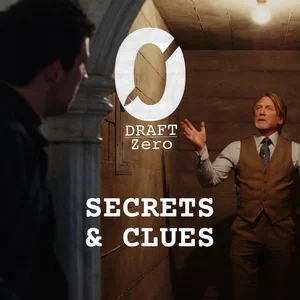
How can Secrets and Clues motivate characters?
AI✦The episode examines how Judd’s voiceover comes from the middle of the film, meaning the narrator has more information than the character experiencing it, which colors his actions with knowledge he doesn’t yet possess.✦
Listen if you want to understand how hidden information drives character motivation and plot structure!
▶
More Info
“Getting information puts your character in danger. And danger rewards your character with information." — One of three ideas we steal from game design in this episode. In this two part series, we talk about how secrets, clues and hidden information motivate characters and may (or may not) help you plot from a character perspective. Part One (this episode) looks at WAKE UP DEAD MAN; while Part Two (DZ-127) looks at SIDE EFFECTS, and the pilot episode of SHRINKING…
→
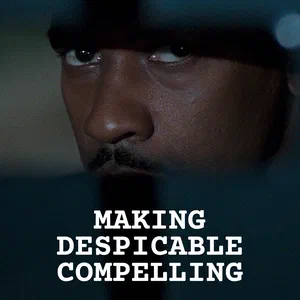
How does Film Noir show us terrible people doing terrible things without endorsing it?
AI✦Chas notes that noir has really strong control over questions, and Woman of the Hour removes the mystery--we know who the killer is from the opening--so the dramatic irony comes from watching Cheryl fail to recognize danger signals that the audience already sees.✦
Listen if you need audiences to root for characters who do terrible things
▶
More Info
Mel and Chas continue to explore what Noir (the genre) can teach writers of all other genres. In particular:…
→
How can you apply horror ideas to action and comedy?
AI✦Stu and Kim spot how a signal can function diegetically for some characters and non-diegetically for the audience--the camera, the lie detector, the nanny cam--creating layers of concealment that drive both tension and comedy.✦
Listen to learn how thinking of your hero as the horror (for your villains) makes your script dynamic.
▶
More Info
In this episode Chas, Stu and guest Kim Ho continue their exploration into the power(s) of antagonism and how focusing on them can develop story…
→
How do the antagonistic forces in your story escalate distinctly from the protagonists' journey?
AI✦The tension in Sinners comes from characters not yet knowing what the audience knows--that Renick is an omen, not a threat--which Chas identifies as the gap between character awareness and audience genre awareness.✦
Listen to strengthen your story by focusing on the antagonistic forces in your script.
▶
More Info
We often struggle to develop the middle stages of a story. Could this be because we focus on our protagonists’ journeys and plot structure more than on how the antagonistic powers are awakened, wronged, discovered, gathering strength and revealing themselves…
→
How do character goals, tactics, and fears create subtext automatically?
AI✦The episode traces how information asymmetry between characters and audience generates subtext in the Michael Clayton and Inglourious Basterds scenes, and how Tarantino uses narrator and flashcut to deliberately manage what the audience knows.✦
Listen if you're struggling to write subtext without it feeling forced!
▶
More Info
Or, how focusing on good drama will result in good subtext. We often hear how subtext is important for good screenwriting. We’re here to tell you it isn’t. Good subtext is a result of good drama, and your focus should be on creating that good drama. But how…
→
How do you dramatise a protagonist's internal journey through their final decision?
AI✦Michael Clayton uses POV structure to make the audience think he’s chosen money when he’s actually betraying the corporation, creating a gap between what we believe and what’s actually happening that serves the film’s thematic purpose.✦
Listen if you want to understand how to better dramatise a character's internal journey
▶
More Info
In this episode, Stu and Chas focus
solely on the final choices made by protagonists and how that reflects their character journey and successfully, or not, dramatises the internal…
→

How can we teach our audience new storytelling rules in the middle of our story?
AI✦In Swiss Army Man, the introduction of Sarah’s point of view--where she has no idea who Hank is despite all his fantasies--creates a dramatic irony that recontextualizes everything preceding it and triggers the tonal shift.✦
Listen if you want to write tonal pivots that land on the page without a director's toolkit.
▶
More Info
Following on from our episodes on
establishing tone through action lines and
through character, this is what we have been building up to: how to pull off a tonal switch… that does NOT throw the audience out of the film. And, in particular, how to pull that off on the page when writers don’t have framing, lighting, music, editing, etc. at our disposal…
→
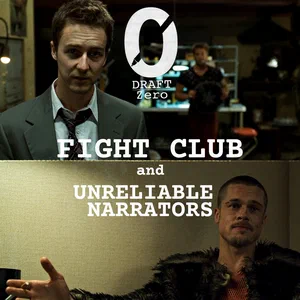
How does the unreliability of a narrator impact the way a story is told?
AI✦The unreliable narration in Fight Club creates dramatic irony where the audience gradually realizes Jack has been withholding or misrepresenting crucial information about what’s actually happening.✦
Listen to learn how unreliable narrators shape storytelling through voiceover, structure, and control.
▶
More Info
In this episode, Stu and Mel (sans Chas!) take a deep dive into FIGHT CLUB and its use of the unreliable narrator. This is a bridging episode between our previous episode on VOICEOVER and our forthcoming episode on TALKING TO CAMERA as Fight Club does
both.…
→
What scene-writing tools can be learned from martial arts?
AI✦Dramatic irony emerges when one character knows they have the advantage (or disadvantage) in proximity and timing while their opponent doesn’t, creating the tension that Damon identifies in scenes like Clarice facing Lecter across the glass.✦
Listen if you want to know why the distance between two characters matters more than what they say.
▶
More Info
In this slightly unusual episode of Draft Zero (but also incredibly on brand), Stu and philosopher-swordsperson Damon Young discuss how the lessons they have learned from martial arts can be applied to scenes. In particular, they discuss how approaching an opponent in a sword fight can be analogous to how characters approach conflict, such as: the distance between the characters, who chooses to engage first, how to feint, how to lure an attack by leaving yourself vulnerable, etc…
→
How can you use setups and payoffs to stitch your film together?
AI✦The audience sees Joy’s identity as Jobu Tupaki through visual pointers long before Evelyn discovers it, creating a sustained irony where viewers watch the protagonist pursue answers the film has already given them.✦
Listen to understand how setups, payoffs, and reversals create narrative cohesion even when your story is fkn bonkers.
▶
More Info
In this one-shot, Chas and Stu jump into the utter chaos of EVERYTHING EVERYWHERE ALL AT ONCE. Y’know, nultiverses, butt-plug action sequences, hot-dog fingers, a raccoon chef, a nihilist bagel. All the good stuff. And yet it lands emotionally in a way that feels inevitable…
→
What is the difference between choice and decision when it comes to characters?
AI✦Separating choice, decision, and consequence allows the audience to know things the character doesn’t, creating emotional effects that depend on what information is withheld or revealed at each stage.✦
Listen how the separation of choice, decision, and consequence (for a character) creates emotional impact.
▶
More Info
In order to better understand dramatising of character, Chas and Stu take a very draft zero look at very specific tool: choices and decisions. We analyse three films through the decisions made by their characters. In particular, how the audience understanding of: the choice available, the considered decision itself, and the consequence changes how we feel about these characters. And how separating those three things can create different emotional effects on your audience…
→
How can interweaving timelines elevate the emotional experience for the audience?
AI✦By cutting between past and present timelines, Gerwig leverages dramatic irony--the audience knows future outcomes while watching earlier selves make decisions--to deepen the emotional impact of character choices.✦
Listen to explore non-chronological structures can make work thematically resonant.
▶
More Info
In our final part, part 3, of our Interweaving Timelines series, we — Chas, Stu & Mel — take a deep dive into Greta Gerwig’s 2019 adaptation of Little Women. In her adaptation of Louisa May Alcott’s iconic novels, Greta chose to interweave the seperate timelines of Little Women and it’s sequel, Good Wives, to create a thematically and emotionally potent work. This differs from all the other adaptations, which have chosen to keep the chronological storytelling of the source material…
→
How can interweaving two timelines change how we feel about a character?
AI✦Flash-forwards in The Social Network create a form of dramatic irony: we know Facebook exists, and the film uses that knowledge gap between past and present to manipulate our emotional experience of Mark’s journey.✦
Listen to understand how manage stakes when you're using flashforwards.
▶
More Info
In this Part 2 of Interweaving Timelines (aka The Stu Monologue Episode), Mel, Chas and Stu tackle Sorkin/Fincher’s The Social Network. As you’ll hear, it is clearly Stu’s favourite of the examples we cover and, ah,
not Mel’s favourite. While all three bring their own biases and opinions on the reality of Facebook as it has become, we do manage to put the destruction of democracy to one side to actually analyse the meticulous craft that this film displays…
→
How does interweaving two timelines change how the audience feel?
AI✦Interweaving timelines inherently creates dramatic irony by showing viewers information about a character’s past or future before the character themselves fully understands it.✦
Listen when you're writting multiple timelines and struggling to anchor your reader to one timeline's perspective.
▶
More Info
Stu and Chas are joined by Mel Killingsworth to dissect interweaving timelines. Not anthology films. Not Cloud Atlas. But films where two plot lines featuring the same characters, but from different timelines, are woven together…
→
How can you let your characters tell us how they feel?
AI✦The power of these scenes comes from the audience knowing (or thinking they know) more than either character, making what they choose to reveal the dramatic engine.✦
Listen to understand why what a character *doesn't* say reveals more than exposition ever could.
▶
More Info
In watching Season 7 (and the first three episodes of Season 8) of Game of Thrones, Stu noticed that there were lots of scenes where characters either met for the first time or were reunited after a long time apart. In these scenes, the audience knows (or thinks they know) more than either character. And so the fascination, power and subversion comes from what the characters choose to reveal... or not…
→
Can one scene be the key to unlocking the whole story?
AI✦Films like HEAT and MARGIN CALL use the key scene to establish what each character knows and doesn’t know about the other, creating the tension that propels the entire narrative.✦
Listen if you want to understand how a single key scene between protagonist and antagonist can unlock the entire structure of your story!
▶
More Info
Can one scene be the key to unlocking the whole story…
→
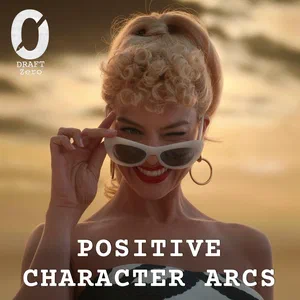
How can repeating the same beat dramatise a character changing?
AI✦Stu observes that Barbie works partly through the audience’s perspective on the character--we feel emotional about her gaining agency even if she resists change, a tension created by the film’s self-aware dramatic irony.✦
Listen to understand how to dramatize a character's internal change.
▶
More Info
Welcome to our third entry in our character arc series; and the first where we talk about characters that
actually change. And positively, too…
→
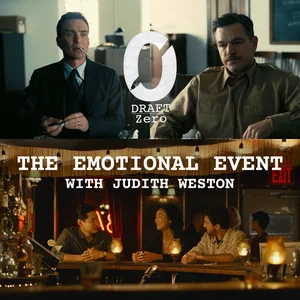
How and why should every scene have an emotional event?
AI✦The close reading of each scene reveals moments where what the audience knows differs from what characters know, and how that gap creates emotional power within the relationship.✦
Listen to understand why a scene's power lives in what shifts between characters, not what happens to them.
▶
More Info
How and why should every scene have an emotional event?…
→
How does removing character and plot question force your audience to engage with theme?
AI✦Works like Love Actually, Apocalypse Now, and The Exterminating Angel use thematic sequences to create distance between what the audience understands and what characters do.✦
Listen if you want to make theme your primary driver (for a sequence)
▶
More Info
Chas and Stu are joined, once again, by the inestimable Stephen Cleary. This episode is a spiritual sequel to our last episode with Stephen, the one on sequence structure. That episode explored how sequences could be broken into plot, character, and plot/character sequences…
→
How does the experience of a character's decision impact our feelings towards that character?
AI✦Sansa’s absence from her own pivotal moment creates a specific form of dramatic irony where the audience watches consequences unfold without access to the character’s knowledge or intention.✦
▶
More Info
After a spectacular end to Season 6 of GAME OF THRONES, Chas and Stu were struck by the very different portrayals of Sansa in
Episode 9 - Battle of the Bastards and Cersei in
Episode 10 - The Winds of Winter. Despite both characters having an enormous impact on the narrative, the audience’s experience of those characters is very different -- largely because Sansa is absent from 98% of Battle of the Bastards…
→
How can the middle of your film pivot so much that it pulls the rug out of your audience?
AI✦Films like Up demonstrate how a well-placed midpoint shift exploits what the audience thought they knew versus what the story actually requires, creating ironic reversals.✦
Listen when your second act sags and you need a structural jolt to accelerate audience engagement.
▶
More Info
Stu and Chas embark on the first of a series of explorations into the dreaded Second Act. Their first stop is midpoint reversals or shifts, a plot point bang in the middle of ACT II that changes the protagonist’s goal, raises the stakes and potentially leaves your audience leaning forward and asking “
How the hell is this going to end?&rdquo…
→
Films:
Death at a Funeral (2007)
,
Prisoners (2013)
,
Short Term 12 (2013)
,
Alien (1979)
,
Aliens (1986)
,
The Bourne Supremacy (2004)
,
Full Metal Jacket (1987)
,
Philomena (2013)
,
How I Live Now (2013)
,
Elysium (2013)
,
Die Hard (1988)
,
Star Wars (1977)