DRAFT ZERO
§ RESOURCES / TOPICS / Audience Questions

Audience Questions

Every episode covering Audience Questions.


"The writers on a macro and a micro level are so in control of the questions they want their audience to be asking at any given time. Do they want them to be asking plot questions? Do they want them to be asking character questions?"

— Chas Fisher  |  DZ-118: ADOLESCENCE -- How Questions Create Dramatic Tension

Start here
DZ-69: PARASITE & Audience Questions

How can you use audience questions to heighten emotional investment?
AIThe episode’s central framing examines how Parasite uses audience questions as a deliberate craft tool to heighten emotional investment throughout the film.
⏱ 1h 22m
10 JUN 2020
Listen to understand how refusing to give your audience moral clarity can deepen their investment in character fates.
More Info
Draft Zero return with their next YouTube livestream! Stu and Chas take a deep dive into PARASITE and how its mastery of audience questions elevates the film. They then answer listeners questions on PARASITE and much more…


KEY IDEAS

Controlling Which Questions Audiences Ask

"The writers on a macro and a micro level are so in control of the questions they want their audience to be asking at any given time. Do they want them to be asking plot questions? Do they want them to be asking character questions?"

— Chas Fisher (01:54:31) · DZ-118: ADOLESCENCE -- How Questions Create Dramatic Tension

Plot Questions Drive Thriller Momentum

"The first episode is a very classic thriller. You're discombulated, you're with the characters, right? You're going through this discombulating experience, you're playing catch up. So there's a lot of these plot questions about like what has happened, what is he accused of, you know, all these kinds of questions, which are kind of plot questions, kind of keep us hooked."

— Stu Willis (00:25:34) · DZ-118: ADOLESCENCE -- How Questions Create Dramatic Tension


Even More

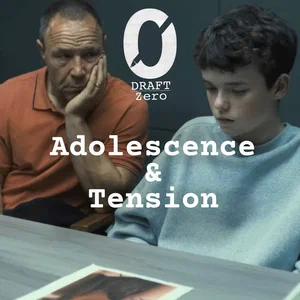
DZ-118: ADOLESCENCE -- How Questions Create Dramatic Tension
How do dramatic questions create tension?
AIStu and Chas show how the writers control which questions the audience asks at any given moment--plot questions in episode one (did Jamie do it?), character questions in episode three (will the psychologist understand him?), and thematic questions by episode four--creating tension regardless of whether plot is actually progressing.
⏱ 2h 0m
1 MAY 2025
Listen when you need tension without external stakes--subtext, stillness, and thematic weight do the work.
More Info
In this episode, Stu and Chas delve into the cultural phenomenon of ADOLESCENCE. We try to find the craft tools that have made the show so compelling and such a catalyst for conversation…


DZ-99: Scene Questions

How do audience questions shape scenes?
AIThe episode’s central thesis examines how plot, character, and thematic questions work together to shape what an audience needs answered in any given moment on screen.
⏱ 1h 34m
1 MAY 2023
Listen if learn how to structure individual scenes through the questions you pose to your audience!
More Info
Inspired by our earlier episodes on sequences, Chas and Stu narrow their focus to look at the atomic unit of screen storytelling: the scene. In particular, we breakdown how question and answers prompted in the audience structure individual scenes…


DZ-46: Structure & Point of View

What questions do you want your audience asking at any given time?
AIThe episode’s central question asks what questions you want your audience asking at any given time, using narrative POV as the mechanism to generate and sustain those questions throughout your story.
⏱ 2h 25m
19 DEC 2017
Listen if you want to understand how narrative point of view can organise your entire story structure
More Info
Waaaaaaaaaay back in DZ-5, Stu and Chas examined how shifting narrative point of view (i.e. what the audience knows in relation to the characters on screen) heightens emotions in any given scene. We’ve now taken that micro idea and applied it to the macro: how can deciding what the audience knows and when in relation to the characters organise your story? Are whole sequences or even acts driven by the audience following a character, feeling concerned about a character, empathising with a character or being absorbed in the irony of knowing more than all the characters interacting on screen…


DZ-5: Shifting audience point of view and heightened emotions

Can forcing your audience to ask questions - and then answering them - trigger an emotional response?
AIThe episode’s central thesis is that forcing your audience to ask questions and then answering them triggers emotional response, making question generation the engine of the craft.
⏱ 1h 29m
27 APR 2014
Listen to learn about the most powerful tool in screenwriting: narrative POV.
More Info
Stu and Chas delve into audience point of view - not character point of view! Does your audience know more, less or the same as your characters? And does changing this within a scene trigger or heighten the desired emotional response…


DZ-114: Climaxes in CHALLENGERS

How does ending your story on the climax affect audience experience?
AIMel notes that the script’s ending would have left her asking ‘oh it’s deliberately making me go tashi is excited about one of them winning the point,’ whereas the filmed version leaves her with an entirely different set of unresolved questions about the three characters’ future.
⏱ 1h 17m
29 NOV 2024
Listen to understand how withholding resolution can make your story great!
More Info
While Stu is on show, Mel and Chas sit down to analyse the meaning behind the ending of 2024’s CHALLENGERS, especially when - upon reading the script - the most impactful moment of the ending on screen (for Chas in particular) is not written on the page…


DZ-78: Interweaving Timelines 1 - Destroyer

How does interweaving two timelines change how the audience feel?
AIStu and Chas examine what questions the interweaving of timelines prompts in viewers, treating audience inquiry as a direct consequence of non-linear storytelling choices.
⏱ 1h 42m
1 APR 2021
Listen when you're writting multiple timelines and struggling to anchor your reader to one timeline's perspective.
More Info
Stu and Chas are joined by Mel Killingsworth to dissect interweaving timelines. Not anthology films. Not Cloud Atlas. But films where two plot lines featuring the same characters, but from different timelines, are woven together…


DZ-53: Antagonists! 5 - vs Audience

What if there is no antagonist?
AIBy making the film itself the antagonist, these works generate questions not about plot but about what the audience is being shown and why -- turning narrative uncertainty into the engine of engagement.
⏱ 2h 26m
26 AUG 2018
Listen to turn narrative uncertainty itself into the engine that keeps viewers compelled.
More Info
It’s time. The Epic Deep Dive(TM) into Antagonists has reached its shuddering conclusion. And for this Part V - by choosing films that have no obvious singular antagonist (and in some cases no obvious narrative either) - Stu and Chas realised there was indeed a final category of antagonists: the films themselves. Where the film (and the filmmaker) are engaging directly with the audience. Where the films are... VERSUS AUDIENCE…