DRAFT ZERO

Process

Every episode tagged Process, newest first.

2024

"this is what the film is going to be about is how emily reacts to pressure and to menace."

— Chas Fisher  |  DZ-107: Establishing Tone through Character
DZ-107: Establishing Tone through Character
How can we use dramatisation to create tone?
AIStu’s tone triangle functions as a generative craft tool–a three-pointed framework for writers to diagnose and adjust the tonal levers they have available in their own scripts.
⏱ 1h 54m
Tone · Structure · Process | 29 FEB 2024
Listen if you want to understand how character actions and reactions shape a film's tone
More Info
In this episode, Chas and Stu continue their deep dive into how to write tone by examining films with “light” (we use the phrase loosely) tones: LADY BIRD, EMILY THE CRIMINAL, THE BALLAD OF BUSTER SCRUGGS, and SPONTANEOUS. We also talk a surprising amount about DUNE and CRAZY STUPID LOVE…


2023

"We’re using oners’s as an… an entry tool… to look at how some writers have chosen to, quote unquote, direct from the page."

— Chas Fisher  |  DZ-101: Oners - Creating Immediacy & Anchoring Action on the Page

DZ-106: How do you know if you have enough story?
How do you know if you have enough narrative fuel to write a script?
AIThe core question–how to know when an idea is ready for first draft–frames development itself as a deliberate, tool-driven process rather than an intuitive leap.
⏱ 1h 36m
Process · Structure · Theme | 31 DEC 2023
Listen you're not sure whether your idea has enough fuel for 90 pages.
More Info
In this episode, Chas, Stu and Mel attempt to answer a listener question: “In your own pre-writing process, how do you know you have enough for a feature? And do you have a specific pre-writing method you’re going to?”
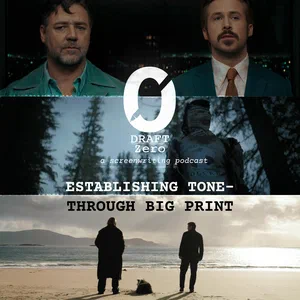
DZ-105: Establishing Tone through Big Print
How can we teach the reader to find the humour in our darkness?
AIThe episode treats tone-setting as a learnable craft with specific levers and techniques that Chas and Stu extract from the opening pages of working scripts.
⏱ 2h 6m
Tone · Process · Genre | 30 NOV 2023
Listen if you want to use an unusual tone in your screenplay.
More Info
Chas and Stu finally start their long-mooted exploration of tone with a series that examines films and shows with unusual tones and dives into how the writers establish those tones in the first 5 pages…


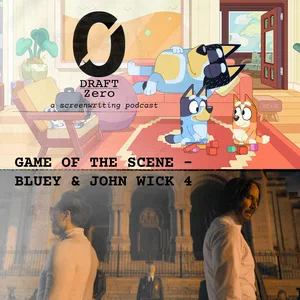
DZ-102: Game of the Scene - Bluey, John Wick 4
How can 'games' help us write better scenes?
AIThe framework of rules, arenas, players, referees, and win conditions functions as a diagnostic tool for writers trying to understand why a scene isn’t landing.
⏱ 1h 23m
Scenes · Audience · Process | 31 AUG 2023
Listen to make your scene writing more dynamic (by looking at the underlying game)
More Info
Stu and Chas turn their attention to a topic that has long eluded them: the game of the scene. We look at how considering the game that characters are playing — its rules, arenas, players, referees, and win conditions — can help you write more dynamic scenes…


DZ-101: Oners - Creating Immediacy & Anchoring Action on the Page
What can we learn by analysing how 'oners' are written on the page?
AIThe episode treats oner construction as a learnable craft tool–breaking down specific techniques from major films to show how any screenwriter can direct the reader’s eye on the page.
⏱ 1h 23m
Scenes · Genre · Process | 3 JUL 2023
Listen to understand how screenwriters direct the camera without calling shots.
More Info
Chas, Stu and Mel reunite to talk about writing the feel of camerawork in screenplays. We use “oners” — a long-playing continuous take — as a lens to talk about how some writers have “directed” from the page. We talk immediacy, camera positions, handovers, and anchoring action and more…


2022

DZ-95: Backmatter - Building and Maintenance
How do you maintain hope in the face of, er, screenwriting
AIThe episode centers on how to maintain hope within an industry described as ‘fickle,’ treating screenwriting as both craft and livelihood.
⏱ 1h 16m
Process · Structure · Genre | 31 DEC 2022
Listen listen to hear why first acts keep shrinking--and whether yours should too
More Info
Time for our annual backmatter episode, where we drop any ruse of any objectivity, and fully embrace our subjective opinions…


DZ-93: Talismans (Part 1)
How can you use physical objects to reveal inner character?
AIChas and Stu position talismans as a concrete craft instrument you can deploy intentionally in your script, distinct from accident or theme, to access and communicate character.
⏱ 1h 37m
Character · Process · Genre | 31 OCT 2022
Listen to so you can write talismans that are powerful tools for accessing character!
More Info
In this series, Chas and Stu discuss TALISMANS. Physical objects that are imbued with meaning by a character or characters. They’re a powerful tool to access inner character…


DZ-86: Backmatter - Minimum Viable Product
How do you determine what is your MVP?
AIStu and Chas share concrete strategies for pitching projects, drawing on their experiences to help writers understand how to present their work to collaborators and gatekeepers.
⏱ 1h 29m
Process · Words | 1 FEB 2022
Listen for screenwriting lessons from 2021, strategies for pitching projects, and insights on running a writers workshop
More Info
In their annual full backwater episode, Stu and Chas let out their pandemic hair, drop the ruse of objectivity, and allow themselves to have even more options about writing and the business of writing…


2021

DZ-81: Pitch Decks & Look Books - Development Tools 4
How do you make effective pitch decks and look books for your projects?
AIMarc Furmie walks through the fundamentals of constructing pitch decks–what they are, how they differ from lookbooks, and what specific materials buyers expect to see.
⏱ 1h 13m
Process · Structure | 30 JUN 2021
Listen if you're preparing to pitch a project and want to understand how to create compelling visual materials
More Info
Chas and Stu are joined by writer/director/producer/multi-hyphenate Marc Furmie of Rezistor Studios to talk all things pitch decks and look books. Coming from an advertising and music video background, Marc shares his experience in putting together visual materials to pitch a project. We discuss the difference between pitch decks and lookbooks, how they help you sell your projects, what buyers are looking for, television vs features, and how do we make yours better…
DZ-77: Backmatter - Prioritising and choosing projects
How do you choose which project to start next?
AIBeginning a new co-writing relationship is explicitly flagged in the listen-if, and Stu and Chas offer subjective opinions on how to navigate that partnership.
⏱ 1h 36m
Process · Character · Genre | 28 FEB 2021
Listen if you're starting a new co-writing relationship, managing multiple projects, or wondering how to prioritize your next screenplay.
More Info
In their now-annual full backmatter episode, Stu and Chas let their hair down, drop the guise of objectivity, and allow themselves to have an even more subjective opinion about writing and the business of writing…


2020

DZ-73: Selling documents - Development Tools 3
How do I write selling documents differently to development documents?
AIStephen unpacks how loglines function differently when written to sell a project versus develop it, making the distinction between these two purposes the structural spine of the episode.
⏱ 39m
Process | 21 OCT 2020
Listen if you're preparing treatments, loglines, or outlines to pitch to producers or agencies.
More Info
In developing our stories and scripts, we have probably written some combination of treatments and loglines and outlines. Some of us have probably even sent these development materials out to producers or agencies when “selling” a project — as a step towards getting someone to read or gulp produce your material. If so… have you written them differently? Should you have? You probably should have&hellip…
DZ-72: Theme & The Story Synopsis - Development Tools 2
How can I develop my theme without writing script pages?
AIThe thematic logline is one of three primary tools Chas, Stu, and Stephen discuss as a means to clarify and dramatize theme during the planning stage.
⏱ 1h 0m
Process · Theme · Character | 28 SEP 2020
Listen tolearn concrete tools for developing theme in the early stages of your writing.
More Info
Continuing our look at tools used in development, Chas & Stu are joined by Stephen Cleary to talk about Theme, The Thematic Logline and what Stephen calls The Story Synopsis. All are tools to help writers better understand their theme and how it is dramatised. We use the classic film WITNESS as an example, so spoilers abound…


DZ-71: Treatments & Loglines - Development Tools 1
How can I develop my plot before writing the screenplay?
AIThe entire episode is framed around development tools and short documents that precede the screenplay, drawing on Cleary’s experience developing work with writers.
⏱ 1h 26m
Process · Structure · Character | 1 SEP 2020
Listen to understand why a treatment isn't something to dread, but the plot-development tool that saves you months of writing.
More Info
Stu and Chas are joined by fan-favourite, Stephen Cleary, to NOT look at what makes great screenplays work – but what makes great “short documents” work. We draw on Stephen Cleary’s wealth of experience in developing work with writers, as a producer, as a script editor and as a former head of development…
DZ-65: Collaborating with a Director - The Snip
HOw does a writer work with a director (on a short film?)
AIChas and Ben walk through the specific mechanics of a writer-director partnership, from pitch through production, showing how creative decisions get negotiated between the page and the set.
⏱ 1h 3m
Process · Character · Genre | 14 FEB 2020
Listen if you are thinking of producing your own short film!
More Info
This episode, Chas steps down as co-host (kinda) and is interviewed by Stu as a guest, alongside director Ben Mizzi, about the short rom-com that Chas wrote and Ben directed & produced. The episode covers taking an idea from pitch to screen, working with a director, directing performance on the page, and marketing and distribution strategies for short films…
DZ-64: Backmatter - Controlling your Work, Treatments, and Writing Styles
What can and should you do next?
AIStu and Chas ground their entire discussion in the practical realities of an emerging screenwriter’s career path and what aspects of it you can actually control.
⏱ 1h 42m
Process · Character | 30 JAN 2020
Listen to understand what you can control in your career--and what you absolutely cannot.
More Info
In our annual Backmatter-only episode, Stu and Chas indulge themselves by offering personal opinions on the life and work of emerging screenwriters based on their own personal experience…

2019

DZ-63: Tools for Better Dialogue 2 - Hook and Eye
How can you create flow and contrast in your dialogue?
AIThe episode explicitly develops reusable dialogue tools–the hook and eye, contrast and affinity, pacing strategies–that writers can apply to their own work.
⏱ 1h 58m
Process · Scenes · Character | 31 DEC 2019
Listen when you're rewriting dialogue and want to create connection between characters.
More Info
A full three years after the first instalment (and one of our most popular), Stu and Chas have kidnapped Stephen Cleary to once again develop some craft tools around dialogue. It would be fair to say that - in that time - all three have learnt a lot more about dialogue than they knew in 2016. It would be also fair to say that Stephen perhaps learnt a little more through his research into “genderlect”…


DZ-62: Unfilmables 3 - As Ifs & Emotional Context
How do you know if your unfilmable is good... or if you're just being a wanker?
AIChas and Stu take scenes from their own projects and demonstrate how to rewrite them using the frameworks they’ve developed across the series, treating unfilmables as a rewriting problem rather than a drafting solution.
⏱ 2h 17m
Words · Process · Character | 2 DEC 2019
Listen if you want to learn how to write tone and emotional context on the page.
More Info
In this third and final part of our series on unfilmables, Chas and Stu turn their critical eye to… each other’s work! They take their key learnings from the previous episodes and apply them to rewriting scenes from their own projects. They discuss metaphors, emotional context, and how you can write tone on the page without resorting to unfilmables…


DZ-60: Unfilmables 1 - Engaging imagination
How can unfilmables enhance the experience of your script?
AIChas and Stu position unfilmables as practical craft tools writers can deploy in micro moments to describe locations, set tone, enhance performance, and land specific types of humour.
⏱ 2h 25m
Words · Tone · Process | 7 AUG 2019
Listen to discover how *produced* screenplays use unfilmables to shape tone, performance, and humour on the page.
More Info
DZ-57: Backmatter - Aesthetics and Forgiveness in Writing
How can you best articulate your ideas?
AIStu and Chas examine how Draft Zero itself has shaped their writing practice over five years, offering emerging writers a model for how produced work feeds back into craft development.
⏱ 1h 29m
Process · Theme | 1 MAY 2019
Listen if you need to forgive yourself (for not writing)
More Info
It is time (in fact, well past time) for our semi-annual #Backmatter episode. For the uninitiated, this is an episode where Stu and Chas discuss career and craft-related topics beyond what makes great screenplays work. To that end, Stu and Chas dive into: a five year review of Draft Zero and how it has changed their writing craft and process; a discussion on the aesthetics of writing; learnings for emerging writers in having their work produced; and finally forgiving yourself for not writing…
DZ-56: Character Motivations (Part 2)
Workshopping ways to fix character motivations.
AIThe episode applies the motivational tools developed in Part 1 as practical rewriting instruments, moving from diagnosis to concrete fixes for broken character moments.
⏱ 2h 16m
Character · Process · Audience | 30 MAR 2019
Listen if you want to understand how character decisions can break a screenplay and how to fix them
More Info
In this second part of their exploration of character motivations, Chas and Stu dive into what makes “BAD” screenplays NOT work. They examine at moments where they (and maybe you, dear listeners) did not believe a key decision being made by a character and so were taken out of the movie. In a departure from the Draft Zero format, they apply the tools they developed in Part 1 to workshop potential fixes to these beats…


2017

DZ-41: Theme and Worldview
How can your characters' worldview dramatise your theme?
AIStu and Chas discuss thematic loglines as a tool for clarifying what your story is about beneath its plot, and how they function differently than standard loglines in anchoring a character’s arc.
⏱ 2h 32m
Theme · Structure · Process | 24 MAR 2017
Listen if theme feels abstract - we talk how how to make it visible through what characters believe.
More Info
In this episode, Stu and Chas tackle one of the more esoteric topics in screenwriting (and writing in general): theme! To help us tackle this topic, we decided to look at television pilots, because we felt that television requires the theme to be more explicit. Our zig-zagging (and long) discussion covers thematic engines, music themes, thematic loglines, punishment vs reward, and - perhaps most of all - the worldview of characters…


DZ-39: Backmatter - Hitting LA, Receiving Feedback, and a Roguish One
How can writers make use of their time when hitting LA?
AIChas shares direct experience navigating LA and the Austin Film Festival, discussing what writers should actually do with their time to build career capital through networking.
⏱ 1h 29m
Process · Character · Words | 15 JAN 2017
Listen if you're about to network at a festival and have no idea what writers actually do with their time there.
More Info
In another backmatter-only episode, Stu & Chas zig-zag through a range of topics. We talk about Chas’ experience(s) hitting both Los Angeles and the Austin Film Festival, effective networking, career capital, the art of receiving feedback, and Stu’s harsh Three Strikes Rule. We look back at the most important lessons we’ve learned about storytelling in 2016 and that leads us to talk about character choices in a little-known and little-talked about film called ROGUE ONE…


2016

DZ-36: Backmatter - Time Risk and Fixing Movies
How can writers wisely invest their time in projects?
AIStu and Chas ground their entire discussion in the practical reality of a working writer’s life: how to allocate limited time across multiple projects without burning out.
⏱ 1h 7m
Process · Structure · Theme | 30 OCT 2016
Listen if you're juggling multiple projects and can't figure out which one deserves your attention right now.
More Info
In this “special”, backmatter-only episode, Stu & Chas take inspiration from Terry Rossio’s excellent article on TIME RISK and ice skate over a range of topics. We talk about time investment in projects, Stuart’s project Restoration, doing you down work first, managing feedback, thinking positive being a negative, and we open the listener mail bag for critiques, praise and suggestions. We also explore how we could do Draft Zero episodes exploring tone and theme…


DZ-33: Protagonist vs Hero - Dawn of Character Function
How does splitting 'character functions' enhance theme?
AIChas and Stu offer character function splitting as a concrete craft tool for writers deciding how to structure their ensemble and reinforce thematic intent through structural choices.
⏱ 1h 58m
Character · Theme · Process | 15 JUL 2016
Listen to see how splitting character functions across your cast sharpens what your story actually means.
More Info
We are often told that our ‘protagonist’ needs to be a active. That they need to be compelling. That they need to change. And - old faithful - that they need to be likeable. But after looking at MAD MAX: FURY ROAD, STAR TREK (2009), THE FIGHTER, and SICARIO, Chas and Stu learn that your primary character does not need to do all these things. In fact, they learn that splitting these functions between your primary characters can reinforce theme and create potential for different types of narratives…


2015

DZ-27: Competing views on Screenplay Competitions
Can screenplay competitions be worth it?
AIStu and Chas use their guest roster–Gordy Hoffman, Diana Gettinger, Monica Hewes, Tony Pitman, and Blake Ashford–to map out how screenplay competitions function as career infrastructure for writers seeking exposure and industry entry points.
⏱ 1h 42m
Process · Genre · Theme | 15 NOV 2015
Listen if you're considering entering a screenplay competition and want to hear from writers and industry professionals about whether it's a worthwhile investment!
More Info
After being repeatedly asked by listeners for thoughts on screenplay competitions, Stu and Chas go full back matter for this special episode. They tackle the question - do comps just feeding the hope machine or are they a valid investment? - in their typical detailed (i.e. long) style. With their differing perspectives, Stu (a director looking for material) and Chas (a writer keen for exposure), talk to an impressive roster of guests. We start with Gordy Hoffman, founder and judge of the Bluecat Screenplay Competition; repeat Austin Film Festival attendees - first for the screenplay and now for the finished web series of EX BEST - Diana Gettinger & Monica Hewes; Launchpad 2014 finalist Tony Pitman; and Insite Competition winner Blake Ashford, whose winning script CUT SNAKE hit cinemas in 2015… ten years after winning the competition…


DZ-26: Horror and Collaboration- Wolf Creek 2
How does a screenwriter collaborate with a director on an existing property?
AIAaron Sterns walks through the specific mechanics of co-writing WOLF CREEK 2 with director Greg McLean, and Chas and Stu use the backmatter to detail their own methods for collaborating with other writers and directors.
⏱ 1h 48m
Process · Genre · Character | 31 OCT 2015
Listen if you're co-writing and need to figure out where your voice ends and your collaborator's begins.
More Info
In this halloween special, Chas (sans Stu) is joined by a very special guest… Aaron Sterns the co-writer of WOLF CREEK 2 – the big budget sequel to the infamous WOLF CREEK, also directed by Greg McLean. Chas and Aaron talk horror, anti-horror, collaboration, novels and how a screenwriter works within an existing franchise…


DZ-23: LIVE - Starting A Career In Film And Television
Are you a filmmaker but not sure how to start your career?
AIMithila, Corrie, and Simon directly address how to break into the industry, what has changed in their own paths, and the practical steps emerging filmmakers need to take.
⏱ 1h 45m
Process | 6 JUL 2015
Listen if you're an emerging filmmaker looking to break into the industry
More Info
Draft Zero was invited to moderate a panel as part of the 2015 St Kilda Film Festival. In our very first live episode, we are joined by TV Writer Mithila Gupta (Winners and Losers), Director Corrie Chen (Reg Makes Contact) and Producer/Executive Simon de Bruyn (*Acquisitions Executive, XYZ Films *and Producer) to talk about ‘breaking in’, how it has changed, the different approaches, opportunities and challenges. They share their tips on networking effectively, setting up an online presence, persevering through doubt and getting relevant experience…


DZ-21: Scene Transitions and the Hook
How can scene transitions do more than just move from one location to another?
AIStu and Stu treat transitions as a concrete, learnable craft tool by reverse-engineering specific examples from HIGHLANDER and AMERICAN SPLENDOR to show which choices were writerly decisions.
⏱ 1h 40m
Process · Scenes · Theme | 7 MAY 2015
Listen to understand how transitions compress time, enhance thematic connections, unify story threads, and orient your reader
More Info

Stu and Chas look at one of the basic building blocks of a script: scene transitions. Transitions don’t just move you from one scene to another in a slick way, they can help you compress time, enhance thematic connections, unify different story threads, orient (or disorient) your reader… and just make your script feel more like a movie…


DZ-19: Car-Crash Characters
How do you make unlikeable characters compelling to watch... in drama?
AIThe episode expands a five-tool list into a more comprehensive toolkit for screenwriters working with unlikeable protagonists in dramatic contexts.
⏱ 1h 59m
Character · Audience · Process | 1 MAR 2015
Listen when you're writing a protagonist who does terrible things but you need the audience to keep watching.
More Info
Stu and Chas revisit a topic from a year ago: how do screenwriters make unlikeable characters compelling? This time, we turn our focus to dramas and analyse how AMERICAN HISTORY X, YOUNG ADULT, NIGHTCRAWLER all make their asshole protagonists compelling to watch. We expand our original list of five writer’s tools to include a few more for your tool belt…


DZ-18: Michael Bay - F*ing the Frame and P*ing the Page
Are there screenwriting lessons to be taken from analysing the work of Michael f-ing Bay?
AIBitter Script Reader presents Bay’s filmography as a toolkit for emerging screenwriters seeking to understand how one of cinema’s most successful directors executes his fundamental storytelling decisions.
⏱ 1h 7m
Genre · Character · Process | 22 JAN 2015
Listen to understand how one of the world's highest-grossing directors structures story, makes great villians, controls information flow, and makes visual decisions on the page
More Info
Of course there are. How could there not be? After all, Michael Bay is the 3rd highest grossing director at the worldwide box office… of all time. Behind, y’know, Spielberg and stuff. How could a man of such credentials not know story? Or, so argues this week’s guest: the author of MICHAEL F-ING BAY: THE UNHERALDED GENIUS IN MICHAEL BAY’S FILMS… [drumroll]… the Bitter Script Reader…


DZ-17: Where's my gold-plated ensuite?
When you're an emerging filmmaker, what are different ways to tackle a "career"?
AIChas and Stu reflect on how their first year of Draft Zero has shaped their own filmmaking careers and debate the relative merits of short films, micro-budget features, and web-based content as career-building strategies.
⏱ 1h 14m
Process · Theme · Genre | 6 JAN 2015
Listen when you're deciding between shorts, features, and web content--and need to know which format actually builds a sustainable creative practice.
More Info
It’s our Holiday Special! In this episode (recorded December 2014), Chas and Stu break all the rules. No homework. No pages. No empirical analysis. They reluctantly but boldly reflect over the first year of Draft Zero and how it has influenced their ‘careers’ (such as they are). They also engage in a heated debate on whether a short film, a micro-budget feature or web-based content is the best way to go in terms of pushing a filmmaking career forward…


2014

"We’re trying to do your homework for you."

— Chas Fisher  |  DZ-0: Welcome to Draft Zero

DZ-16: Masters of Time and Whitespace
Does manipulating time on the page make your script feel more cinematic?
AIKhrob brings Soviet Montage Theory and the Kuleshov effect into the conversation as specific craft tools screenwriters can apply to recreate time manipulation on the page.
⏱ 1h 49m
Words · Genre · Process | 16 DEC 2014
Listen if you want your screenplay to feel cinematic before a director ever reads it.
More Info
DZ-12: Craft, Career and Coffins
It's the The Podcast You Used To Know…
AINatasha Pincus walks through her trajectory as a screenwriter, director, and actor, making this a direct conversation about navigating multiple roles in the industry.
⏱ 1h 1m
Process · Character · Genre | 16 SEP 2014
Listen if you're navigating multiple creative disciplines and wondering how to build a sustainable career across them.
More Info
Well, half of us is… Chas (sans Stu) is joined by a very special guest - Natasha Pincus. As a screenwriter, Tash’s feature CLIVE was on the 2012 Black List. As a director, her music video for Goyte’s Someone I Used To Know was nominated for an MTV Music Video Award. And at the time of this recording, her debut feature as a screenwriter FELL was weeks away from opening night…


DZ-7: On Rewriting - How much Bull is left in the Hustle?
What can be gleamed from the substantial rewrite of a famed spec?
AIStu and Chas use the transformation from AMERICAN BULLSHIT to AMERICAN HUSTLE as a case study in how substantial rewrites reshape a spec into a studio film.
⏱ 55m
Process · Character · Theme | 25 MAY 2014
Listen to learn how impactful rewriting can be.
More Info
Stu and Chas look at AMERICAN BULLSHIT (the 2010 Black List spec script by Eric Warren Singer) and the film it became… AMERICAN HUSTLE (co-written and directed by David O’Russell), which garnered 10 Oscar nominations in 2014…


DZ-0: Welcome to Draft Zero
What, exactly, is Draft Zero?
AIChas and Stu are explicit that their toolkit functions mainly as a rewriting instrument rather than a generative one, helping you achieve the effect you want on an audience once you have a draft.
⏱ 9m
Process · Character · Theme | 1 FEB 2014
Listen if you're new to the podcast and want to understand our philosophy on screenwriting craft!
More Info
Welcome to Draft Zero. A message from 2019 to those starting with our first episodes dating from 2014. We’ve learned a lot in five years. So where do you begin…